Search for pizza dough calories and you'll mostly find numbers for store-bought dough or a single generic "pizza crust" entry. Neither tells you much about the dough you actually make at home, which depends on your flour, how much water you use, whether you add oil or sugar, and how big you make each ball.
The good news is that homemade dough is one of the easiest things in your kitchen to calculate. Almost all of the calories come from one ingredient, and you're already weighing it.
The short answer: a lean homemade pizza dough (flour, water, salt, yeast) has about 205 to 230 calories per 100g raw. A dough ball for a 12-inch pizza comes to roughly 515 to 650 calories depending on style, or about 65 to 85 calories per slice before sauce, cheese, and toppings.
If you want those numbers for your own recipe, the PizzaLogic dough calculator gives you exact gram weights for every ingredient, and the formula below turns them into calories in about ten seconds.
Pizza Dough Calories by Style
These numbers come straight out of the PizzaLogic calculator using each style's default recipe: its usual flour, hydration, salt, oil, and sugar, at the dough weight the calculator uses for a 12-inch round or a 10x14-inch pan. Calories are for raw dough, before toppings.
| Style | Dough weight | Per 100g | Per pizza | Per slice (8) |
|---|---|---|---|---|
| Neapolitan | 249g (12") | 217 kcal | 539 kcal | 67 kcal |
| Canotto | 283g (12") | 204 kcal | 578 kcal | 72 kcal |
| New York | 283g (12") | 228 kcal | 646 kcal | 81 kcal |
| Same-day | 283g (12") | 230 kcal | 652 kcal | 82 kcal |
| Calzone | 283g (12") | 228 kcal | 646 kcal | 81 kcal |
| Bar / Tavern | 215g (12") | 239 kcal | 515 kcal | 64 kcal |
| Chicago deep dish | 509g (12") | 300 kcal | 1,526 kcal | 191 kcal |
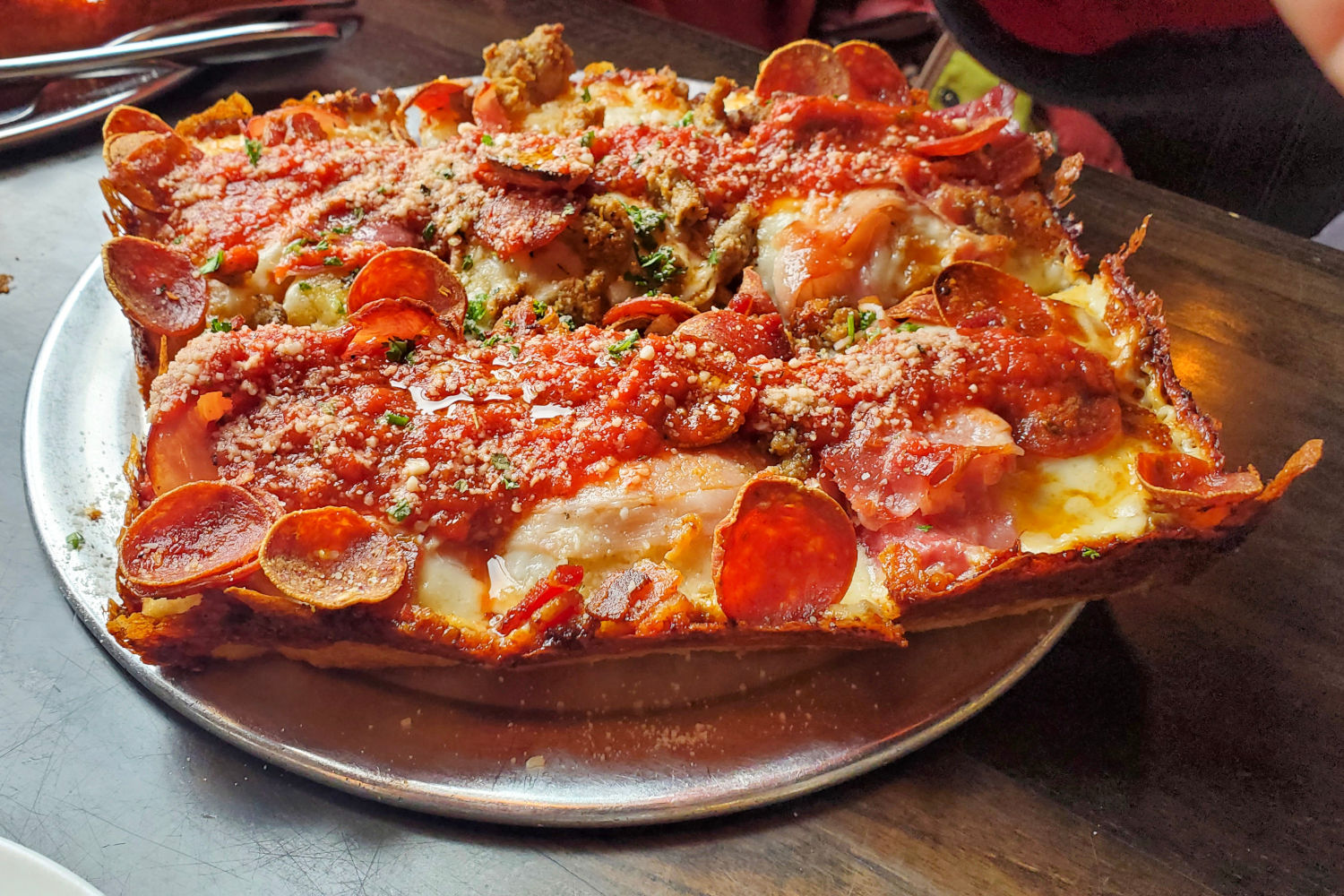
| Detroit | 770g (10x14 pan) | 216 kcal | 1,660 kcal | 208 kcal |
| Sicilian | 742g (10x14 pan) | 215 kcal | 1,597 kcal | 200 kcal |
A few things jump out:
- Thin styles win on total calories, not on calories per gram. Bar pizza is actually the most calorie-dense of the lean doughs per 100g because it's the driest (55% hydration). It comes in lowest per pizza only because the ball is small.
- Pan pizzas are big. Detroit and Sicilian dough is about as lean per gram as Neapolitan, but a 10x14 pan holds nearly three times as much of it. A slice of Detroit-style pizza carries nearly three times the dough of a New York slice.
- Deep dish is the outlier. Chicago-style dough is traditionally made with a lot of fat (18% in the calculator's default), which pushes it to 300 calories per 100g, the highest of any style.
Why Flour Is Almost the Whole Story
Here's what each ingredient in a typical dough contributes, per 100g of that ingredient:
| Ingredient | Calories per 100g |
|---|---|
| Flour (bread flour) | 361 |
| Water | 0 |
| Salt | 0 |
| Olive oil | 884 |
| Sugar | 387 |
| Honey | 304 |
| Dry yeast | 325 |
Water and salt have no calories at all, and yeast is used in such tiny amounts (often under 1% of the flour weight) that it barely registers. In a lean Neapolitan dough, over 99% of the calories come from flour.
That makes the math simple. You don't need to count the dough, you need to count the flour.
The Formula
For any homemade pizza dough:
Calories ≈ (flour g × 3.6) + (oil g × 8.8) + (sugar g × 3.9)
Use 3.0 for honey instead of 3.9. Ignore water, salt, and yeast.
Here's how it works on a New York-style batch made with 500g of bread flour, 2% oil, and 2% sugar:
- Flour: 500g × 3.6 = 1,800 calories
- Oil: 10g × 8.8 = 88 calories
- Sugar: 10g × 3.9 = 39 calories
- Total: about 1,930 calories for the whole batch
Divide by the number of dough balls and you have calories per pizza. Divide the whole batch's calories by its total weight and multiply by 100 for calories per 100g.
If your recipe is written in baker's percentages, this is even easier, because flour is always 100% and everything else is already scaled to it.
Does Hydration Change the Calories?
Yes and no. Adding water doesn't add or remove any calories. But it does change how many calories are packed into each gram of dough, because a wetter dough has less flour per gram.
Here's 100g of the same bread flour dough at different hydration levels:
| Hydration | Calories per 100g |
|---|---|
| 55% | 229 kcal |
| 60% | 222 kcal |
| 65% | 216 kcal |
| 70% | 209 kcal |
| 75% | 204 kcal |
| 80% | 198 kcal |
So a 280g ball of 75% dough really does have fewer calories than a 280g ball of 60% dough, about 8% fewer. It's not magic, it's just a little less flour in the ball. If you make a wetter dough but scale up the ball to get the same thickness, the savings disappear.
This is also why high-hydration dough can look lighter on a nutrition label without being any lighter on the plate.
Does Flour Type Change the Calories?
Less than you'd think, but it changes the protein more. Here's the same Neapolitan-style dough (62% hydration, 3% salt, 250g ball) made with each flour the calculator supports:
| Flour | Per 250g ball | Protein per ball |
|---|---|---|
| All-purpose | 552 kcal | 15.7g |
| Bread flour | 547 kcal | 18.3g |
| High-gluten | 547 kcal | 21.3g |
| Semolina | 546 kcal | 19.3g |
| 00 (soft) | 541 kcal | 17.4g |
| 00 (strong) | 541 kcal | 19.0g |
| Light rye | 541 kcal | 15.0g |
| Whole wheat | 516 kcal | 20.1g |
| Spelt | 513 kcal | 22.2g |
White flours all land within about 2% of each other. Whole wheat and spelt come in about 6% lower, mostly because part of their weight is fiber, which provides fewer calories than starch.
The bigger story is protein. A spelt or high-gluten dough ball has 35-40% more protein than the same ball made with all-purpose flour. If you're choosing a flour for nutrition reasons, protein is where the real difference is. If you're choosing it for the pizza, the best flour for pizza dough depends much more on your style and your oven.
Oil and Sugar: The Small Additions That Add Up
Oil is the most calorie-dense ingredient in any dough, at nearly 2.5 times the calories of flour by weight. Here's a 280g New York-style ball at different oil levels:
| Oil (baker's %) | Per 280g ball |
|---|---|
| 0% | 611 kcal |
| 2% | 633 kcal |
| 4% | 655 kcal |
| 6% | 676 kcal |
Each 2% of oil adds roughly 20 calories per ball. That's real, but it's modest. The bigger oil source on most pizzas is what gets drizzled on top or poured into the pan, which isn't part of the dough at all.
Sugar has an even smaller effect. The 1-2% used in New York and same-day doughs adds about 5 to 15 calories per ball.
What About Sourdough?
Sourdough pizza dough lands within a few percent of the same recipe made with commercial yeast, and usually slightly lower. A sourdough starter is just flour and water, and a liquid starter carries more water per gram of flour than the dough itself, so it nudges hydration up a little.
Fermentation does consume a small amount of the flour's sugars, but not enough to make a meaningful difference to the calorie count. Long cold fermentation is great for flavor and digestibility. It isn't a calorie-cutting technique.
Raw vs. Baked: Why the Numbers Online Don't Match
Every number in this post is for raw dough. That matters, because baking changes the weight but not the calories.
In the oven, some of the dough's water evaporates. The calories stay put. So the crust weighs less after baking, and each gram of it carries more calories.
For example, if a 250g dough ball at 541 calories loses 30g of water in the oven, you're left with a 220g crust that still has 541 calories. That's 217 calories per 100g raw, but about 246 per 100g baked.
This is one reason nutrition databases disagree so much. A "pizza crust" entry might be raw dough, baked crust, or a commercial dough with added oil, sugar, and conditioners. If you're logging your own pizza, the cleanest way is to log the raw dough you actually made and not worry about what happens in the oven.
How to Lower the Calories in Your Pizza Dough
Since flour is nearly all of it, the levers are simple:
- Make smaller or thinner dough balls. This is the only change that makes a big difference. Going from a New York-style 283g ball to a bar-style 215g ball cuts about 130 calories per pizza.
- Skip the oil in the dough. Saves about 20 calories per ball for every 2% you drop. Neapolitan dough has none at all.
- Use whole wheat or spelt for part of the flour. About 6% fewer calories at 100%, less in a blend, with more protein and fiber either way.
- Watch the toppings. On most pizzas the cheese, oil, and meat add as many calories as the crust, or more. The dough is rarely the main event.
Changing your yeast, salt, or fermentation time won't move the number in any meaningful way.
If you're also watching sodium, I covered that separately in how to make a low-sodium pizza crust.
How PizzaLogic Calculates Dough Nutrition
The PizzaLogic app includes a nutrition estimate as part of PizzaLogic Pro. It shows calories, carbs, protein, and fat for each dough ball and per 100g of raw dough, based on your actual recipe:
- Your flour or flour blend. Each flour type has its own nutrition profile, and blends are weighted by how much of each flour you use.
- Everything in the batch. Flour and water in a biga, poolish, or levain, plus oil, sugar or honey, and malt, all count.
- Sourdough handled correctly. Starter is counted as flour and water, not as yeast.
Change the flour from 00 to whole wheat and the numbers update instantly. All values use USDA nutrition data and are estimates for raw dough, before toppings.
The nutrition estimate is only in the mobile app. The web calculator gives you the exact gram weight of every ingredient, which is all you need to use the formula above.
Frequently Asked Questions
How many calories are in 100g of pizza dough?
About 205 to 230 calories for a lean homemade dough (flour, water, salt, yeast), depending on hydration and flour. Dough with a lot of oil, like Chicago deep dish, can reach 300.
How many calories are in 200g of pizza dough?
About 410 to 460 calories for a lean homemade dough. A 200g ball makes a thin 10- to 11-inch pizza.
How many calories are in a 12-inch pizza crust?
Between about 515 and 650 calories for the dough, depending on style. A thin bar-style crust is at the low end, a New York-style crust at the high end.
How many calories are in a slice of pizza crust?
For a 12-inch pizza cut into 8 slices, about 65 to 85 calories of dough per slice. Pan pizzas like Detroit and Sicilian run about 200 per slice because each piece has far more dough.
Does cooking pizza dough change the calories?
No. Baking drives off water, so the crust weighs less and has more calories per gram, but the total calories in the crust stay the same as the raw dough.
Want the exact grams for your next bake? The PizzaLogic dough calculator works out flour, water, salt, oil, and yeast for any style, size, and schedule. Plug the flour and oil into the formula above and you'll know your dough's calories before it hits the oven.