Almost every pizza recipe hands you a single yeast number. "1 teaspoon of instant yeast." "7 grams of active dry." One number, no context, as if the same amount works whether you're baking in six hours or three days.
It doesn't. The right amount of yeast for pizza dough isn't a fixed quantity you look up - it's an amount you size to how long and how warm your dough is going to ferment. A dough that rises on the counter in an afternoon needs a very different amount than one that spends three days in the fridge, and getting that relationship wrong is the single most common reason a dough over-proofs into a sticky, boozy mess or never rises at all.
This guide covers how much yeast for pizza dough you actually need, why how much yeast in pizza dough is really a question about time and temperature, and how to convert between instant, active dry, and fresh yeast so the number on your scale matches what you actually own. Everything here mirrors the exact math the PizzaLogic pizza dough calculator runs, so I'll also show you what's happening under the hood.
The Short Answer
If you just want numbers, here they are. These are for instant dry yeast at typical pizza hydration (around 62-65%), no sugar, at sea level, expressed both as a baker's percentage and as grams per 500g of flour.
| Fermentation Schedule | Instant Yeast % | Per 500g Flour |
|---|---|---|
| Same-day (about 6 hours at room temp) | 0.11% | ~0.55 g |
| Overnight to next lunch (2h room + 16h fridge) | 0.23% | ~1.15 g |
| Next-day dinner (2h room + 22h fridge) | 0.21% | ~1.05 g |
| Two-day cold ferment (2h room + 46h fridge) | 0.16% | ~0.80 g |
| Three-day cold ferment (2h room + 70h fridge) | 0.13% | ~0.65 g |
Two things probably jump out. First, these are tiny numbers - well under a gram for a two-pizza batch. Second, the relationship isn't what most people expect: the overnight dough needs the most yeast, not the least, and the three-day cold ferment needs less than the overnight one. That's not a typo, and understanding why is the whole game.
You'll also see bigger numbers elsewhere. Plenty of recipes call for a whole packet, and some guides quote a range like 0.5% to 2% yeast. Those are almost always built for a fast, warm, same-hour rise, or they're quoting fresh yeast, which you need roughly three times as much of (see the conversions below). For proper pizza fermentation with instant yeast, the amounts really are this small - and if a recipe has you dumping a full packet into a two-pizza dough, that's a sign it's chasing speed, not flavor.
Why "How Much Yeast" Has No Single Answer
Yeast is a living organism doing a job: eating sugars in the flour and releasing carbon dioxide that inflates your dough. How much you need depends entirely on how much time the yeast has to do that job, and how warm it is while working.
The mistake is thinking about time as clock time. What actually matters is what I'd call fermentation activity - and cold time barely counts.
Here's the key fact: yeast activity roughly doubles for every 18°F of warmth (in the normal range), and it nearly shuts off in the fridge. At 70°F, yeast works at full speed. At 38°F - standard fridge temperature - it works at about one-twentieth of that pace. So an hour on the counter accomplishes as much fermentation as roughly twenty hours in the fridge.
That single fact explains the whole table above:
- A same-day dough spends all 6 hours warm, so it gets about 6.5 "warm-equivalent hours" of real fermentation. That's a lot of active time, so it needs very little yeast (0.11%).
- An overnight dough gets maybe 2 hours warm plus 16 hours cold. Those 16 cold hours only count for about 0.8 warm-equivalent hours, so the yeast really only has about 2.8 active hours to fully leaven the dough. To finish that fast, it needs more yeast (0.23%).
- A three-day cold ferment stacks up 70 cold hours, which finally adds up to about 3.5 warm-equivalent hours on top of the initial 2 warm ones - roughly 5.5 active hours total. More active time means less yeast (0.13%).
So the fridge isn't where your dough does most of its rising. It's where it develops flavor and waits for you on your schedule. The rise mostly happens in the warm hours on either end. Once you internalize that, the counterintuitive numbers make perfect sense: short warm time plus a cold hold needs a decent amount of yeast, and only very long cold ferments let you cut the yeast way down.
It's also why two doughs with the same clock time can need completely different amounts of yeast. A dough left out for 24 hours at room temperature gets a full 24 hours of active fermentation, so it needs barely a whisper of yeast - well under 0.1%. A dough given 2 hours out and 22 hours in the fridge covers the same 24 hours on the calendar but only gets about 3 hours of real fermentation, so it needs roughly twice as much. "A 24-hour dough" tells you almost nothing until you know how much of that time was warm. This is exactly the distinction most recipes gloss over when they hand you one number.
The arithmetic to hit an exact percentage for a given schedule is fiddly, but the principle behind it is simple: more equivalent fermentation time means less yeast.
Yeast Type Changes the Number: Instant vs Active Dry vs Fresh
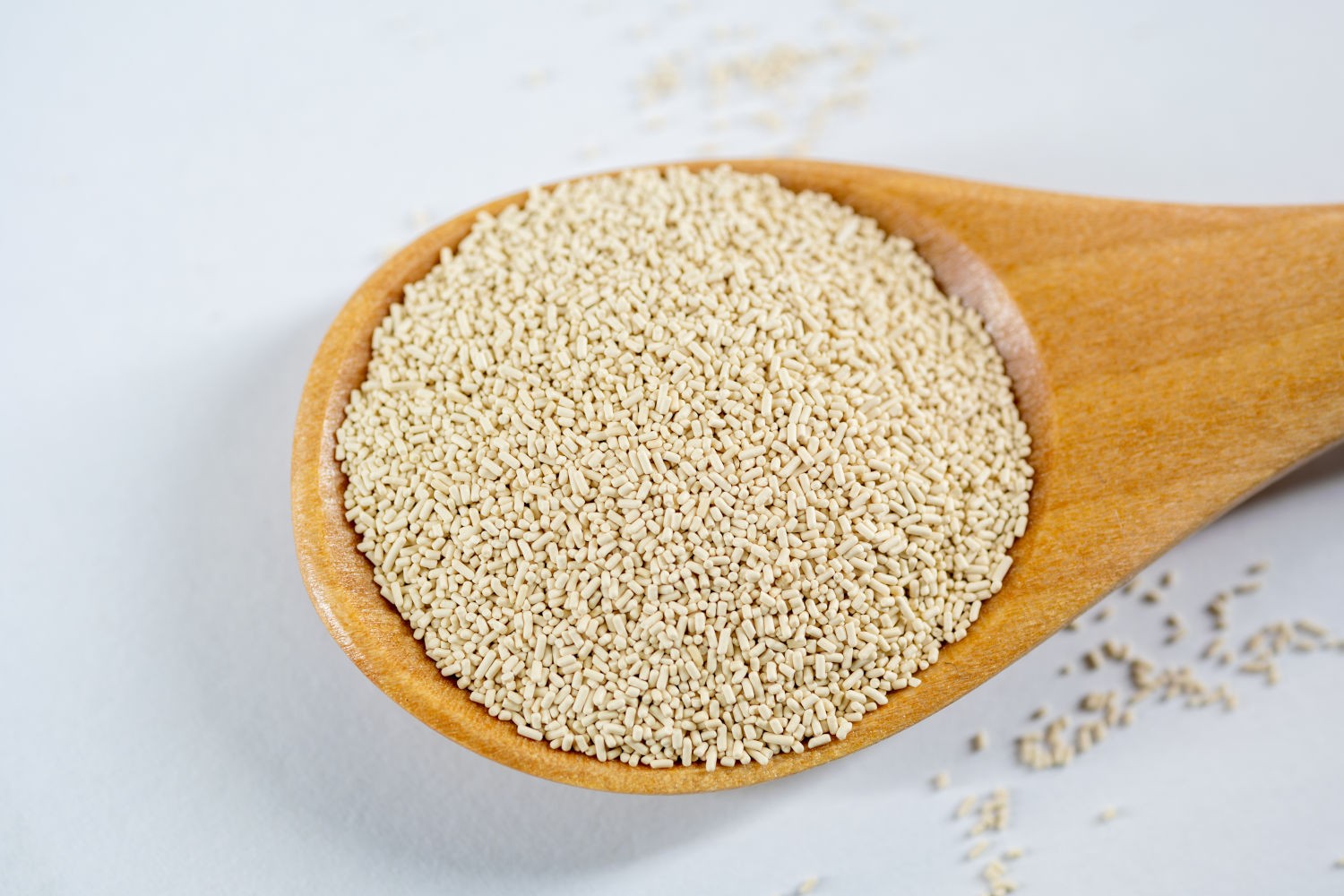
Before you weigh anything, you need to know which yeast you're holding, because the three common types are not interchangeable gram-for-gram. They're the same organism at different moisture levels and cell concentrations, so you need different amounts to get the same leavening power. (For a full breakdown of the types and which to buy, see my guide to the best yeast for pizza dough - this section is only about converting the amount.)
Instant dry yeast is the most concentrated, so it's the baseline. To match the same leavening power with another type, multiply:
| Yeast Type | Multiply Instant By | Example (from 0.55 g instant) |
|---|---|---|
| Instant Dry Yeast (IDY) | 1.0 | 0.55 g |
| Active Dry Yeast (ADY) | 1.25 | 0.69 g |
| Fresh / Cake Yeast (CY) | 3.0 | 1.65 g |
So if a recipe or the calculator gives you a number in instant yeast and all you have is active dry, multiply by 1.25. Going from a recipe written in fresh yeast back to instant? Divide by 3.0.
One practical note on active dry: older active dry yeast benefits from blooming before it goes in. Dissolve it in a little warm water - around 105 to 110°F, no hotter or you'll kill it - and let it sit 5 to 10 minutes until it foams. Instant yeast and fresh yeast can go straight into the mix without that step. (Modern active dry is often fine added dry, but blooming is a free insurance check that it's still alive.)
What About Sourdough?
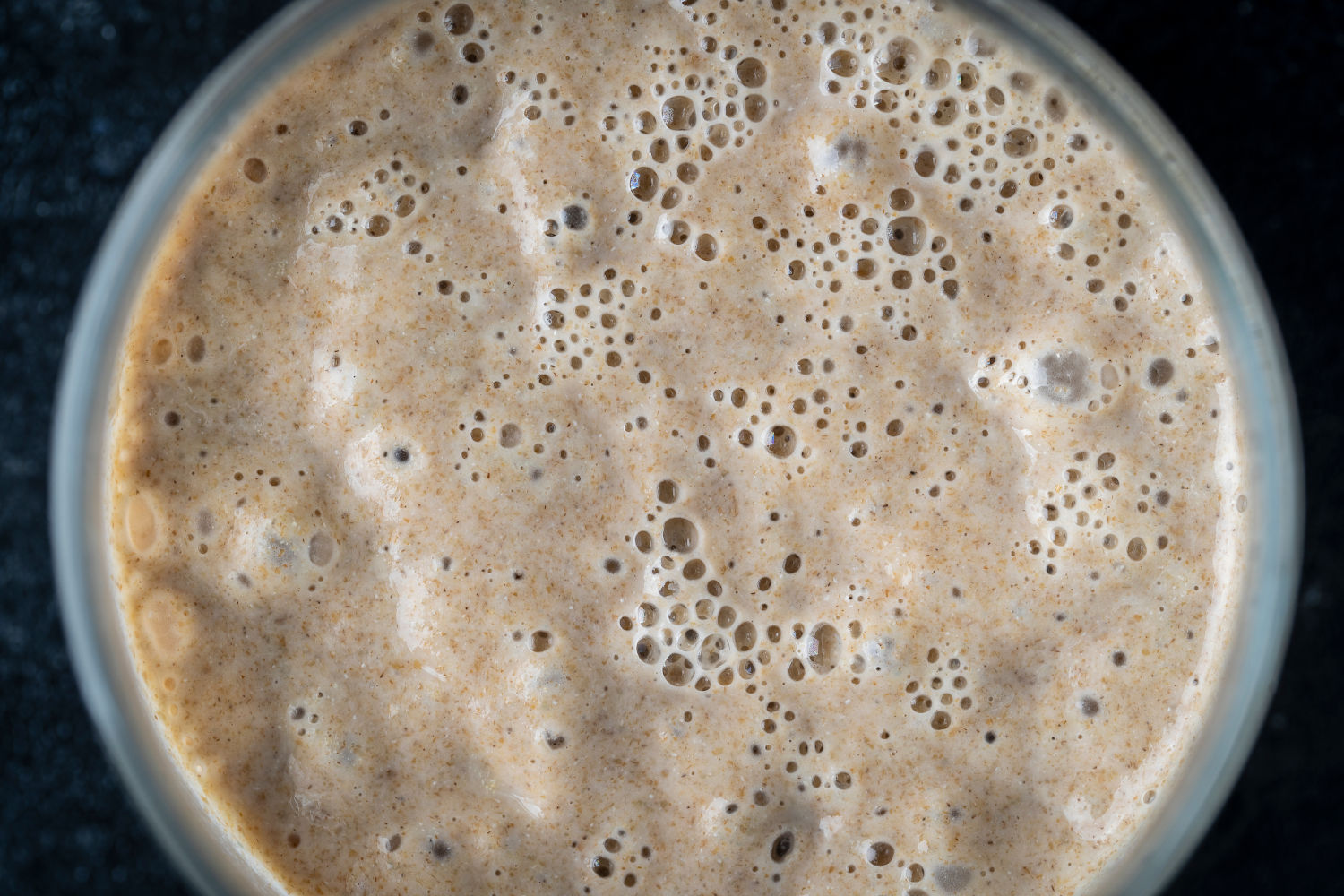
Sourdough is why this table stops at three types. A sourdough starter (a levain) isn't measured yeast at all - it's a live culture of wild yeast and bacteria that you build up and feed, and you dose it by the weight of starter, usually somewhere around 10 to 30% of the flour weight, rather than by a fraction of a gram. It ferments more slowly and less predictably than commercial yeast and brings its own acidity to the crust, so there's no clean gram-for-gram number that would let it sit in the table above. If you're leavening with a starter, the question shifts from "how much yeast" to "how much active starter, and how long" - enough of a topic to deserve its own post. The short version: use roughly a fifth of your flour weight as active, bubbly starter to begin with, and give it a longer, warmer rise than you would a commercial-yeast dough.
How Much Yeast by Flour Weight
Because yeast is dosed as a percentage of flour, the gram amount scales with your batch. A percentage like 0.15% instant yeast works out to:
| Flour Weight | Instant Yeast at 0.15% |
|---|---|
| 250 g (one to two pizzas) | ~0.38 g |
| 500 g (two to three pizzas) | ~0.75 g |
| 1,000 g (four to five pizzas) | ~1.50 g |
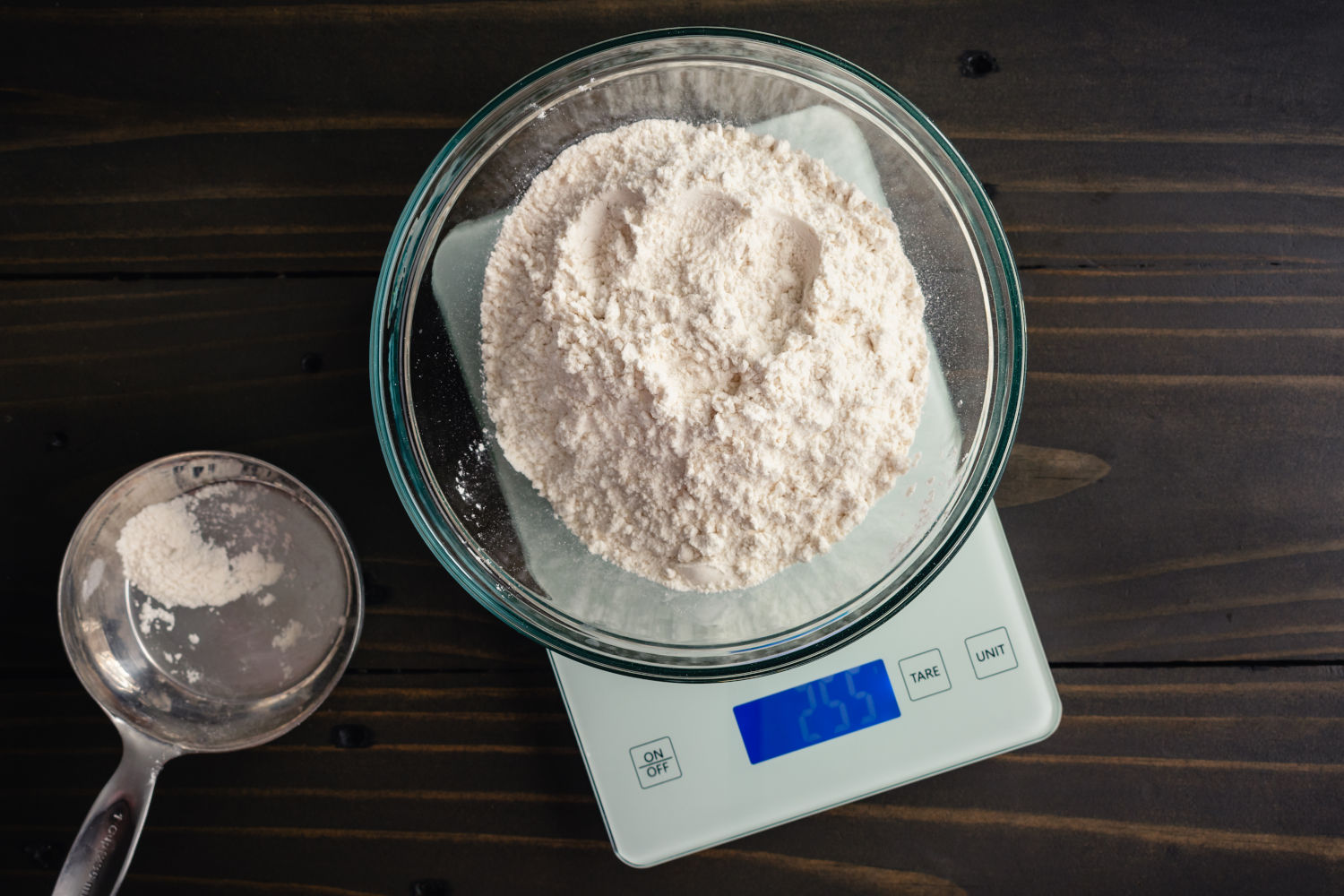
This is where a lot of home doughs quietly go wrong. When your target is 0.4 grams, a standard kitchen scale that only reads in whole grams is useless - it'll show "0 g" or jump straight to "1 g," which at this scale is a 150% error. That's the difference between a properly proofed dough and one that races past its peak.
For small batches, this is the strongest argument for a cheap jeweler's scale that reads to 0.01 grams. It costs about $15 and it's the only way to hit a sub-gram yeast target reliably. For larger batches where your yeast amount climbs above a gram or two, a normal 1-gram kitchen scale is fine.
For a sense of scale against what you've got in the cupboard: a standard packet of yeast holds about 7 grams, and a teaspoon of instant yeast is roughly 3 grams. Line those up against the amounts in this guide and the point lands - a whole batch of pizza dough usually needs a small fraction of one teaspoon, not a packet. That's the gap between how bread recipes and speed-focused pizza recipes dose yeast and what a properly fermented pizza dough actually wants.
PizzaLogic Tip: The calculator outputs your yeast amount in grams for your exact batch size and yeast type, so you never have to scale a percentage by hand or guess at a teaspoon conversion.
What Else Nudges the Number
Time and temperature do most of the work, but a few other variables push the yeast amount up or down. The calculator folds all of these in automatically; here's what each one does so you understand the output.
- Hydration. Wetter doughs ferment faster because the yeast moves and feeds more easily, so they need slightly less yeast. A slack 80% Detroit dough gets a small reduction; a stiff 55% bar-pizza dough gets a small bump. The swing is modest, roughly plus or minus 10% at the extremes.
- Sugar. A little sugar (up to about 4%) feeds the yeast and speeds things up, so the dough needs marginally less. A lot of sugar (above 8%, as in some dessert-style or enriched doughs) actually slows yeast down through osmotic pressure, so it needs more. Most pizza sits at 0 to 2% sugar, where the effect is small.
- Salt. Salt restrains yeast, which is a feature - it keeps a long ferment from running away. The calculator accounts for heavy salt (above 3.5%) by widening the fermentation window rather than changing the base yeast dose.
- Altitude. Lower air pressure lets dough rise faster, so high-altitude bakers need a touch less yeast. Above about 3,000 feet this starts to matter, and the reduction scales with elevation.
- Preferments. If you're building a biga or poolish, the yeast is split between the preferment and the final dough, and the preferment gives the whole build a head start that reduces the total yeast needed. That's a different calculation, which those two guides cover in depth.
None of these override the core time-and-temperature relationship. They're refinements on top of it.
Can You Use Too Much Yeast?
Yes, and it's a more common mistake than using too little. Extra yeast doesn't make a better pizza - it makes a faster, worse one.
Overyeasted dough races through fermentation and hits its peak before you're ready, then keeps going and over-proofs: the gluten structure exhausts itself, the dough goes slack and sticky, it loses its ability to spring in the oven, and it can pick up a boozy, sharply yeasty smell and flavor from the alcohol and excess byproducts the overworked yeast leaves behind. If you've ever had a dough balloon up in the fridge overnight and deflate into a wet blob by day two, too much yeast (or too little salt) is usually why.
The fix is not to eyeball "a bit less." It's to match the dose to the schedule. A dough built for a three-day ferment with a same-day amount of yeast will blow out long before day three. This is precisely the failure the amounts in this guide are designed to prevent - and if a dough still isn't cooperating, my guide to pizza dough that won't rise walks through the other causes.
Erring slightly low on yeast is almost always safer than erring high. A little-underleavened dough just needs more time; an overyeasted one is often unrecoverable.
How the Calculator Figures This Out
Everything above is what happens inside PizzaLogic every time you set a schedule. Here's the actual sequence:
- You enter your room-temperature hours and temperature, and your cold-ferment hours.
- It converts those into equivalent fermentation activity, weighting warm hours fully and cold hours at a fraction, using the same temperature curve described earlier.
- It solves for the base instant-yeast percentage that lands the dough perfectly proofed at the end of that window.
- It adjusts for your hydration, sugar, salt, and altitude.
- It converts to your chosen yeast type (instant, active dry, or fresh) and multiplies by your batch size to give you an exact gram weight.
That's a calculation with five or six moving parts, run every time you change an input, which is why a single recipe number can never be right for every schedule. The amount that's perfect for your Friday same-day pie is wrong for your Sunday cold-ferment, and the calculator is simply doing the arithmetic that connects them.
Summary
The short version, if you take nothing else away:
There is no single "right" amount of yeast for pizza dough. The amount depends on how long and how warm your dough ferments, and the two are not the same - a warm hour does roughly twenty times the fermentation work of a cold one.
Use the schedule table as your starting point. Same-day doughs need very little yeast (around 0.11% instant). Short overnight doughs with a cold hold actually need the most (around 0.21 to 0.23%). Only long, multi-day cold ferments let you cut the dose back down.
Know your yeast type and convert. Instant is the baseline; multiply by 1.25 for active dry and 3.0 for fresh. They are not interchangeable gram-for-gram.
Weigh it, and weigh it precisely. At sub-gram amounts a whole-gram scale isn't accurate enough - a $15 jeweler's scale pays for itself in doughs that actually proof on schedule.
When in doubt, go slightly low. An underyeasted dough just needs more time. An overyeasted one over-proofs and usually can't be saved.
Get the amount matched to your schedule and fermentation stops being a guessing game - the dough is ready when you planned for it to be ready, not blown out a day early or stubbornly flat.
Not sure what your schedule works out to? The PizzaLogic dough calculator takes your timing, temperature, yeast type, and style and gives you the exact yeast weight in grams - along with everything else in the recipe - and saves it so you can dial it in from one bake to the next.