
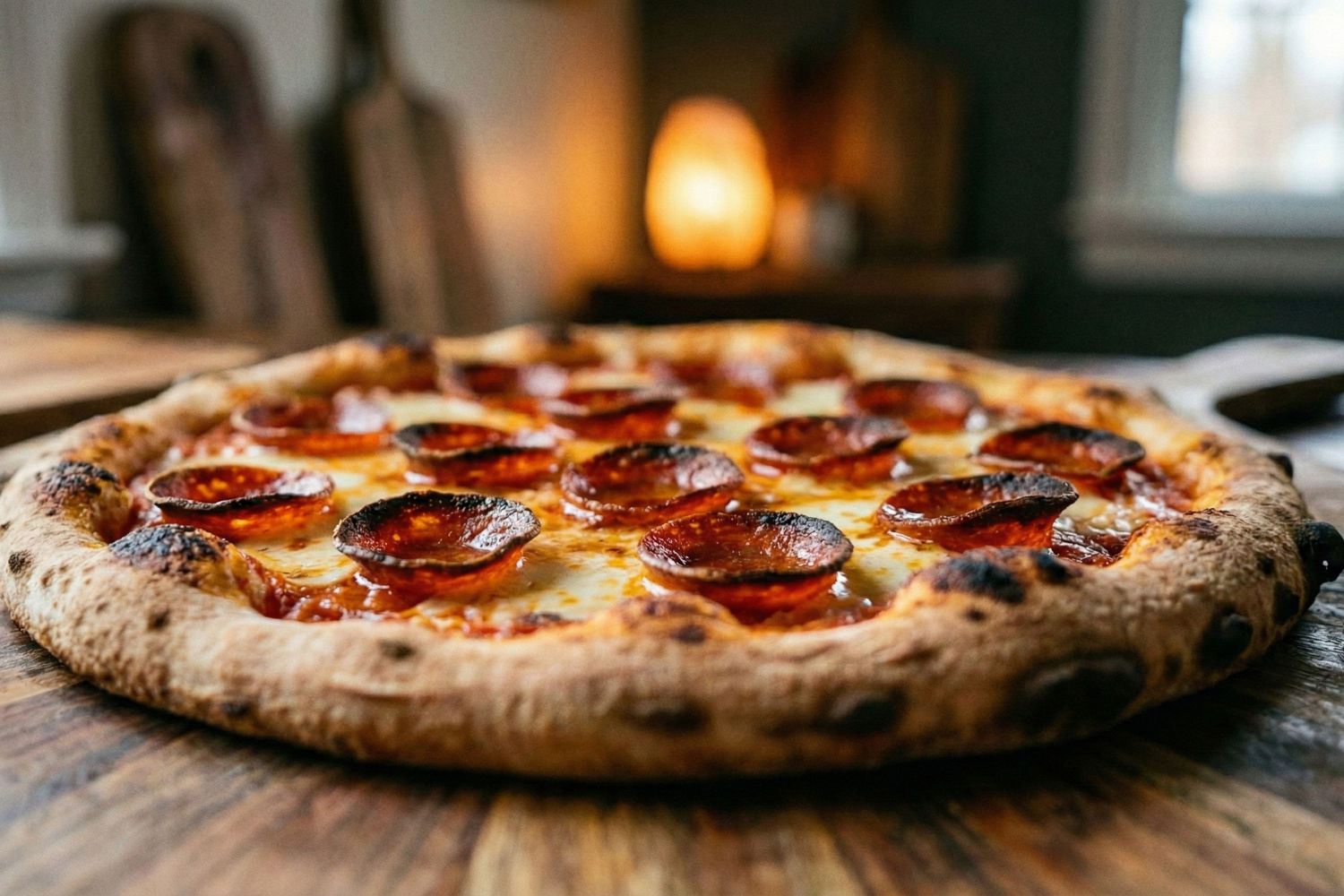
If you've spent any time on pizza Instagram, you've seen them: tiny bowls of pepperoni with charred, crispy edges and a little pool of spicy oil sitting in the center. That's cup and char pepperoni - sometimes called cupping pepperoni, old world pepperoni, or just roni cups - and for a lot of home pizza makers, it's the single upgrade that makes the biggest difference on a finished pie.
But not all pepperoni does this. Most of what you'll find pre-sliced at the deli counter will lay completely flat when baked. So what's actually going on? Why does some pepperoni curl into cups while the rest just sits there? And more importantly, how do you make it happen at home?
Let's get into it.
A Quick History: From Buffalo Accident to Instagram Sensation
Cup and char pepperoni wasn't invented on purpose. It was just what happened when you made pepperoni the old way.
In the early days of American pepperoni production, all pepperoni was stuffed into natural casings - animal intestines - which were left on the product when it was sliced and put on pizza. When those slices hit the heat of a pizza oven, the casing shrank, the edges pulled up, and you got a cup. That was just how pepperoni worked. Battistoni Italian Specialty Meats, founded in Buffalo in 1931 by Italian immigrant Umberto Battistoni, is one of the earliest commercial producers of this style and is still making it today (source).
After World War II, the food industry pivoted hard toward efficiency and uniformity. Manufacturers started using fibrous casings - reinforced with cellulose - that were stripped off before slicing. The result was perfectly round, perfectly flat pepperoni that was cheaper to produce, easier to portion, and covered more surface area per ounce. That "lay-flat" style became the national default (Hormel).
But Buffalo never switched. Neither did parts of the Midwest - Cleveland, Detroit - where the old-school natural-casing style stayed the standard. Cup and char wasn't a trend there. It was just pepperoni (The Sauce by Slice).
The style went national thanks to two things: Prince Street Pizza and Instagram. Prince Street opened in NYC in 2012, and their "Spicy Spring" square slice - loaded with cupping pepperoni - became one of the most photographed pizzas on the internet (WKBW). Then in 2016, Columbus-based Ezzo Sausage Company started supplying their artisanal cupping pepperoni more widely to NYC pizzerias, and the trend exploded. Shops started listing "Ezzo pepperoni" on their menus the way a steakhouse lists its beef supplier (Salvo 1968).
Today, cup and char has gone from regional quirk to something close to the default at quality-focused pizza shops. And for good reason.
Why Does Pepperoni Cup? The Science
J. Kenji López-Alt tackled this question in depth for his Food Lab column on Serious Eats, running a series of experiments with different pepperoni types, thicknesses, casings, and heat sources. His findings are the foundation for basically everything written about this topic, so let's walk through what he found.
There's no single reason pepperoni cups. It's several factors working together:
The casing matters - but not the way you'd think. Natural and collagen casings do shrink when heated, which pulls the edges of the slice upward. But López-Alt found that pepperoni still curled even when he completely removed the casing before baking. That means the casing is an accelerator, not the sole cause. What's really happening is that the process of being stuffed into a natural casing creates lasting structural changes in the meat itself (Serious Eats).
The stuffing process creates a "U-shape" in the meat. When pepperoni is forced through a narrow stuffing horn into a wider casing, friction against the horn walls slows the outer meat while the center moves faster. This creates a U-shaped flow pattern in the cross-section of the log. That pattern gets locked in during curing. When you slice the log into coins and heat them, the meat "remembers" that shape and curls accordingly (Serious Eats). Industrial flat pepperoni avoids this by using stuffing horns that nearly match the casing diameter, creating a straight, uniform fill with no internal tension.
The heat gradient does the heavy lifting during baking. On a pizza, the bottom of each pepperoni slice is insulated by cheese and dough - both excellent insulators. The top is exposed to the hot air and radiant heat of the oven. So the top surface dries out and contracts faster than the bottom, forcing the edges to curl upward. Once the edges lift, they're even more exposed to heat, which accelerates the process (Serious Eats, Tasting Table).
The takeaway: you need pepperoni that was originally stuffed into a natural or collagen casing (even if the casing isn't still on), sliced to the right thickness, and baked in a way that maximizes the heat difference between the top and bottom of the slice.
How to Get Cup and Char at Home
Start With the Right Pepperoni
This is the single most important step. You cannot make lay-flat pepperoni cup, no matter what you do with your oven. The manufacturing process determines whether cupping is even possible.
What you're looking for is sometimes labeled "old world pepperoni" - though most stores don't label it that way. Instead, look for a stick (not pre-sliced) that's brick-red in color, hard, lumpy on the outside, and relatively small in diameter - around 35–40mm across. That smaller circumference produces bite-sized slices that cup more readily than the wide rounds from a big deli log (Thursday Night Pizza).
Check the casing: if the outside of the stick looks like it has a thin, slightly translucent skin, that's a natural or collagen casing - good. If it's smooth and plasticky, it's fibrous - that pepperoni will lay flat.
Here are the brands worth knowing:
Ezzo Sausage Company (Supreme line) - Widely considered the best cup and char pepperoni available. Deep cups, intense char, slightly spicier than most. The catch: Ezzo is primarily a wholesale/B2B operation, so you can't buy it at a grocery store. You'll need to order from a specialty retailer like Penn Mac in Pittsburgh, or check if your local pizzeria will sell you a stick. Worth the effort if you're serious about your pepperoni game.
Battistoni Cup & Char - The heritage Buffalo choice. Naturally wood-smoked, semi-dry cured, available in both spicy and mild. You can order directly from their site or find them on Amazon. Uses a collagen casing that produces a reliable "pop" into cup shape. If you want to taste what Buffalo pizza has tasted like for 90+ years, this is the one.
Hormel Cup N' Crisp - The grocery store option. Available at Target, Walmart, and most major supermarkets. It comes pre-sliced, which means you lose some control over thickness, but it cups reliably in a standard home oven. The flavor is more straightforward than Ezzo or Battistoni - some pizza enthusiasts find it a little "processed" - but for accessibility, it's hard to beat. The "Bold" version is a noticeable upgrade over the original.
For a much deeper dive into grocery-store options, NEPA Pizza Review tested and ranked a bunch of widely available brands with video for each. It's a great resource if you're working with what's on the shelf at your local store.
Slice It Right
If you bought a whole stick (which you should, whenever possible), thickness is your most important variable.
López-Alt's testing found that the ideal range for cupping is 2.5mm to 5.6mm (roughly 0.1 to 0.22 inches). Within that range, most home pizza makers - including the folks at Thursday Night Pizza - find that about 3mm (⅛ inch) is the sweet spot. That's approximately the thickness of two quarters stacked together.
Go thinner than 2.5mm and the slices don't have enough structure to hold a cup - they'll wilt into the cheese. Go thicker than about 6mm and the slice is too stiff and heavy for the thermal contraction to overcome. It just sits there like a hockey puck (Serious Eats, Food Republic).
A couple of slicing tips that make a real difference:
Chill the stick before slicing. Put the pepperoni log in the freezer for 15–20 minutes before cutting. The cold firms up the fat, which gives you cleaner cuts and keeps the casing intact. A mandoline will give you the most consistent results, but a sharp chef's knife works fine if you take your time.
Let the slices warm up before baking. This is a tip you don't see often, but the logic is sound: cold pepperoni straight from the fridge takes longer to reach the temperature where the casing starts contracting. If your pizza finishes baking before the pepperoni has had a chance to fully cup, you get shallow bowls instead of deep cups. Letting your sliced pepperoni sit at room temperature for 20–30 minutes before topping your pizza can help.
Bake It Right
You've got the right pepperoni, sliced to the right thickness. Now the oven has to do its part.
Pepperoni goes on top of everything. This seems obvious, but it's worth stating: the pepperoni must be the uppermost layer on your pizza. If cheese, sauce, or other toppings are sitting on top of the pepperoni, they add insulation and weight that prevent the edges from curling. The whole mechanism depends on the top of the slice being exposed to direct heat while the bottom is insulated by cheese and dough.
Get your oven as hot as it goes. Crank it to 500–550°F (or higher if you have a pizza oven) and preheat your baking surface for at least 45 minutes to an hour. The hotter the oven, the greater the temperature differential between the top and bottom of the pepperoni, and the better the cup.
A baking steel outperforms a pizza stone for this. Steel has much higher thermal conductivity than ceramic, so it transfers heat to the dough faster and recovers its temperature more quickly. That intense bottom heat helps the pizza cook faster overall, which means the pepperoni spends more of its bake time in that sweet spot where it's cupping and charring rather than just warming up (Serious Eats).
The broiler trick. This is probably the single most impactful technique for home ovens. Place your pizza stone or steel on an upper rack - about 4–5 inches from the top heating element. Bake your pizza normally until it's almost done, then switch the oven to broil for the last 60–90 seconds. That blast of intense radiant heat from above rapidly crisps the edges of the cups and creates the char. Keep a close eye on it - the line between "perfect char" and "burnt" is about 30 seconds.
Pat the pepperoni dry. If your slices have any surface moisture from condensation or packaging oil, the oven's energy goes toward evaporating that moisture before the Maillard reaction (browning) can begin. A quick pat with a paper towel before topping removes that barrier.
Why It's Worth the Effort
A good roni cup gives you three distinct textures in a single bite. The rim is crispy and brittle - almost bacon-like, as López-Alt describes it. The walls have that classic cured-meat chew and snap. And the base stays soft and juicy, sitting in a concentrated pool of rendered spicy oil that acts like its own built-in sauce (Serious Eats).
Flat pepperoni gives you one texture. Cup and char gives you a gradient, and that contrast - between crisp and soft, between charred and succulent - is what makes people obsessive about it.
If you want to push it even further, try finishing your pizza with a drizzle of hot honey (Mike's Hot Honey is the classic choice) right out of the oven. The sweetness and extra heat against the salty, charred pepperoni is outstanding. A few small dollops of ricotta or a scattering of pickled peppers work for the same reason - they cut through the richness of all that rendered oil.
Get the Dough Right, Too
Cup and char pepperoni gets all the attention, but it's only as good as the pizza underneath it. If your dough is off - too thick, too thin, under-proofed, over-hydrated - even perfect roni cups can't save the pie.
That's what PizzaLogic is for. Our dough calculator takes the guesswork out of pizza dough by letting you dial in your exact flour weight, hydration percentage, salt, yeast, and oil ratios for any style - New York, Neapolitan, Detroit, Sicilian, whatever you're going for. You set the parameters, PizzaLogic does the math, and you get a recipe scaled precisely to the number of dough balls you need.
Because if you're going to the trouble of sourcing Ezzo Supreme and slicing it to exactly 3mm on a mandoline, you should probably also know that your dough is dialed in. Try PizzaLogic free →
Sources linked throughout. The foundational resource for the science of pepperoni cupping is J. Kenji López-Alt's "The Pizza Lab: Why Does Pepperoni Curl?" on Serious Eats. For hands-on grocery store brand testing, see NEPA Pizza Review's Pepperoni Power Rankings. For a practical home baker's guide, see Thursday Night Pizza's cup and char walkthrough.