
Look, you put real effort into making that pizza. You dialed in the dough with your pizza dough calculator, you nailed the fermentation, you got that beautiful crust out of the oven - and now you've got leftovers sitting in the fridge. The last thing you want is to turn all that work into a soggy, rubbery disappointment.
Here's the thing most reheating guides won't tell you: how you should reheat your pizza depends entirely on what kind of pizza you made. A thin Neapolitan behaves completely differently from a thick Detroit-style slice when you hit it with heat. The crust hydration, the cheese blend, the thickness of the base - all of it matters.
So if you've ever wondered how to reheat pizza without losing what made it great in the first place, this is the guide you've been looking for. I'm going to walk through every method worth trying, explain the actual science behind why each one works (or doesn't), and help you pick the right approach for your specific pizza.
Why Leftover Pizza Is Tricky in the First Place
Before we get into methods, it's worth understanding what's actually happening to your pizza in the fridge - because it explains everything about why some reheating methods work and others are a disaster.
Starch Retrogradation
The biggest enemy of leftover pizza is starch retrogradation. When your dough bakes, the starch granules absorb water and gelatinize - that's what gives you a tender, chewy crumb. But as the pizza cools and sits in the fridge, those starch molecules slowly recrystallize and push out moisture. The result? A crust that feels stiff, dry, and stale even though it's only a day old.
The good news: retrogradation is reversible. When you reheat the crust above about 150°F (65°C), those starch molecules loosen up again and reabsorb moisture. This is why properly reheated pizza can taste nearly as good as fresh - you're literally undoing the staling process.
Moisture Migration
The other issue is moisture migration. Your sauce is constantly transferring water into the crust and cheese. In the fridge, this continues slowly, which is why the bottom of day-old pizza often feels soggy while the toppings have dried out. The best reheating methods address this by driving moisture out of the crust quickly (usually with direct bottom heat) while gently warming the toppings above.
Fat Crystallization
Cheese changes texture in the fridge because the milk fats solidify. Getting those fats to melt back into that stretchy, flowing state is what makes reheated pizza feel right again. You need sustained heat above about 130°F to get the fats moving, and ideally above 170°F for proper re-melting depending on the cheese blend you used.
How to Reheat Pizza in the Oven
Best for: Multiple slices, thick-crust styles (Detroit, Sicilian, pan pizza), any pizza where you want even results across several slices at once.
The oven is the most popular reheating method for good reason - it's the closest environment to what originally baked your pizza. If you've got more than a couple slices to reheat, this is almost always the best way to reheat pizza.
The Standard Oven Method
-
Preheat your oven to 375°F (190°C). A lot of guides say 350°F, but I find 375°F gives you better crust re-crisping without drying out the toppings. If you made a very thin crust, you can push this to 400°F.
-
Use a preheated baking sheet or pizza stone. This is the step most people skip, and it's the single biggest difference-maker. Put your baking sheet or pizza stone in the oven while it preheats. That direct contact heat from below is what re-crisps your crust and drives out the moisture that's been migrating into the bottom overnight.
-
Place your slices directly on the hot surface. No parchment paper, no foil - you want that direct contact. If you're worried about sticking, a very light brushing of oil on the sheet works fine.
-
Heat for 8-10 minutes. You're looking for the cheese to be fully melted and just starting to bubble, and the crust edges to be firm and slightly toasty. Thick crusts like Detroit-style might need a full 12 minutes.
The Foil Tent Technique
If you've found that oven reheating dries out your toppings before the crust is properly crisp, try this variation: loosely tent the slices with aluminum foil for the first 5-6 minutes, then remove the foil for the last 3-4 minutes. The tent traps steam initially (keeping toppings moist and helping the cheese melt evenly) while the uncovered finish lets the crust crisp up.
This works especially well for heavily topped pizzas where the toppings insulate the cheese from the oven heat.
Oven Reheating Tips
- Never reheat pizza in a cold oven. Starting in a cold oven means a slow, uneven warmup that dries everything out before it properly heats through.
- A pizza stone or pizza steel is the upgrade. If you bake pizza at home regularly (and if you're reading this blog, you probably do), a preheated stone or steel gives you noticeably better bottom crust than a sheet pan. It holds more thermal energy and transfers it faster.
- Spritz with water for extra-dry slices. If your pizza has been in the fridge for two or three days, a quick mist from a spray bottle before it goes in the oven helps counteract the moisture loss. Don't drench it - just a light mist over the top.
- Crack the oven door for the last minute if you want extra-crispy crust. This lets steam escape and gives you a drier, crunchier finish.
Reheat Pizza in Air Fryer: The Best Quick Method
Best for: One to three slices at a time, when you want speed without sacrificing quality, and thin to medium-crust styles.
If I had to pick one reheating method as the overall best balance of speed and quality, it's the air fryer. The rapid circulating heat does something that no other quick method can match - it re-crisps the crust and re-melts the cheese almost simultaneously, and it does it in a fraction of the time an oven takes.
How to Reheat Pizza in an Air Fryer
-
Preheat your air fryer to 350°F (175°C). Some models heat up in under two minutes, which already gives you a massive time advantage over the oven. If your air fryer doesn't have a preheat function, just run it empty for 2 minutes.
-
Place slices in a single layer in the basket. Don't overlap them. Air fryers work because of circulation - if you stack slices, you kill the airflow and end up with unevenly heated pizza. Depending on your air fryer size, this usually means 1-3 slices at a time.
-
Heat for 3-4 minutes. That's it. Check at 3 minutes - thin crust pizza is usually done, while thicker slices might need the full 4 minutes or even 5 for something like a deep dish.
Why the Air Fryer Works So Well
The air fryer is essentially a small convection oven. The concentrated, rapidly moving hot air hits the pizza from all angles, which means the bottom crisps, the cheese melts, and the toppings warm through almost simultaneously. In a regular oven, you often have the crust done before the cheese is fully melted (or vice versa). The air fryer narrows that gap considerably because of how efficiently it transfers heat.
Air Fryer Reheating Tips
- Line the basket with perforated parchment if needed. Some air fryers have grates that cheese can drip through. Perforated air fryer parchment liners solve this while still allowing airflow. Don't use regular parchment - it blocks the air circulation that makes the whole thing work.
- Drop the temp for extra-thin crust. If you made a very thin, cracker-style crust, bring the temperature down to 325°F. Thin crusts can go from perfectly crispy to burnt in about 30 seconds at higher temps.
- Bump it up for deep dish. Thick, doughy pizza styles benefit from starting at 325°F for 4 minutes (to heat through the thick base), then bumping to 375°F for a final 1-2 minutes to crisp the top.
- Don't be afraid of a second round. If the crust isn't as crispy as you'd like but the cheese is perfect, pull the slice, let it rest 30 seconds, and hit it for another 60 seconds. The rest lets internal moisture redistribute, and the second blast crisps the exterior without overcooking the toppings.
Reheat Pizza on a Pan (The Skillet Method)
Best for: Single slices, when you want the absolute crispiest bottom crust, Neapolitan and New York-style pizza.
The skillet method is the darling of pizza purists, and for good reason. If bottom crust crispiness is your top priority - and if you made a beautiful thin crust that deserves to shine - this method delivers results that arguably beat the oven.
The Basic Skillet Method
-
Place your slice in a cold, dry skillet. Non-stick or cast iron both work. Starting cold gives the crust time to warm evenly before the bottom starts to crisp.
-
Turn the heat to medium-low. You want patient, steady heat here - not a screaming hot pan. Medium-low lets the crust crisp slowly while the residual heat works its way up through the toppings.
-
Cover the pan and heat for 5-7 minutes. The lid is critical. It traps heat and creates a mini-oven effect that melts the cheese from above while the direct contact heat crisps the bottom. Without a lid, you'll end up with a perfectly crispy bottom and cold cheese on top.
-
Check the bottom at 5 minutes. Lift a corner with a spatula - you're looking for golden brown, not blackened. If it's there but the cheese isn't fully melted, keep the lid on and drop the heat to low for another minute or two.
The Water Trick (Skillet + Steam)
This is the version that went viral online a few years ago, and it actually works well:
After step 2, once the crust is starting to warm up (about 2 minutes in), add 2-3 drops of water to the bare part of the pan - not on the pizza itself. Immediately cover with a lid. The water creates a burst of steam that melts the cheese quickly and helps rehydrate the crust slightly.
The key is restraint with the water. Too much and you'll steam your crust into sogginess. You literally only need a few drops.
Skillet Reheating Tips
- Cast iron is king here. Cast iron's heat retention and even distribution give you a more uniform crisp than thin non-stick pans. If you use cast iron for baking pizza (and you should be), it's a natural choice for reheating too.
- A tiny amount of oil levels things up. If the bottom of your leftover slice is uneven (bubbles, charred spots), a very thin film of olive oil in the pan helps even out the contact and gives you a more uniform crisp.
- Don't press down on the slice. It's tempting, but pressing squeezes out moisture and compresses the crumb structure you worked to create.
- This method struggles with thick pizza. Detroit-style and deep dish don't do great in a skillet because the thick base takes too long to heat through - by the time the center is warm, the bottom is burned. Stick with the oven or air fryer for those styles.
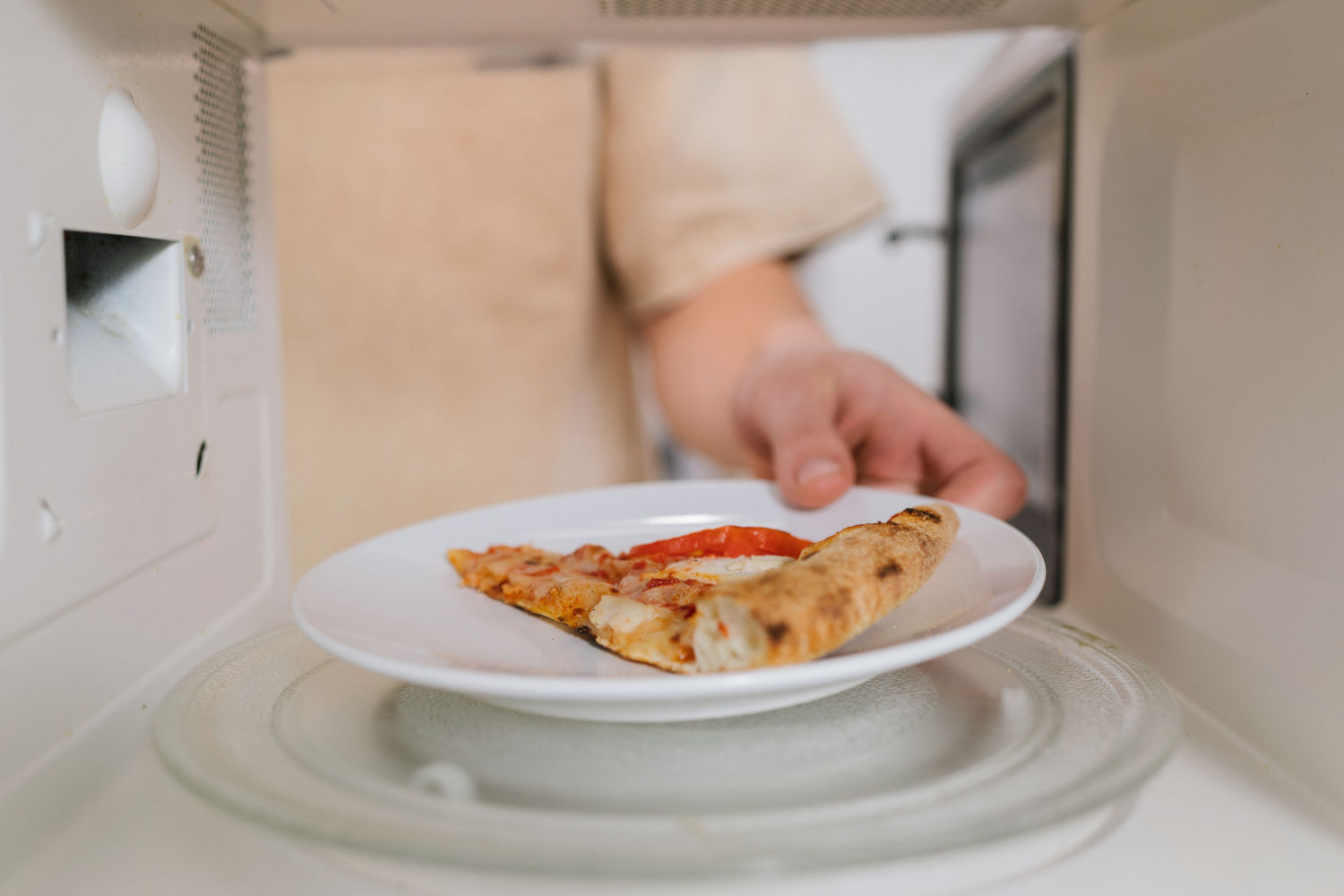
Best Way to Heat Up Pizza in the Microwave (Without Ruining It)
Best for: When you're in a rush and texture isn't your top priority, or as the first step in a two-stage method.
Let's be honest: the microwave has a terrible reputation for reheating pizza, and it's mostly deserved. Microwaves heat by agitating water molecules, which means they're essentially steaming your pizza from the inside out. That's the opposite of what you want for crust crispness.
But there are situations where the microwave makes sense - especially if you use it smartly.
The Right Way to Microwave Pizza
-
Place a microwave-safe mug of water next to your pizza. This is the oldest trick in the book, and it actually works. The water absorbs some of the microwave energy, which slows down the heating of your pizza and reduces the rubbery cheese effect. It also adds a small amount of humidity to the microwave, which helps prevent the crust from turning into cardboard.
-
Use medium power (50-70%). Full power is too aggressive. Dialing it back gives the heat time to distribute more evenly through the slice.
-
Heat in 30-second intervals. Start with 30 seconds, check it, and go another 15-30 seconds if needed. Most single slices are done in 45-60 seconds total. Overshooting even slightly can turn cheese into rubber.
The Microwave-Then-Finish Combo
Here's what I actually recommend when people say they want to microwave: use the microwave as step one, then finish with any of the other methods in this guide.
Microwave the slice on medium power for 30 seconds - just enough to take the chill off and start softening the cheese. Then immediately finish it off using your method of choice. A hot skillet for 60-90 seconds gives you a crispy bottom fast. An air fryer at 375°F for 1-2 minutes crisps everything up. Even a quick stint in a preheated oven or toaster oven works - just cut the normal reheating time roughly in half since the pizza is already warm.
The microwave handles the internal warming quickly, and the second method provides the texture and crispness that the microwave can't. The whole process takes 2-4 minutes depending on which finish you choose, and the results are surprisingly close to using the slower method from the start.
Microwave Tips
- Paper towel underneath helps. It absorbs some of the moisture that the crust releases, keeping the bottom slightly less soggy.
- Microwave-safe plate matters. A room-temperature ceramic plate is better than plastic - it provides a small amount of indirect heat from below as it warms up.
- Never stack slices in the microwave. The overlapping areas will heat unevenly and you'll get hot spots and cold spots.
- Accept the limitations. Even with all these tricks, the microwave won't give you a crispy crust. It can give you warm pizza with decently melted cheese that's acceptable when speed is the priority.
The Toaster Oven Method
Best for: One to two slices, a solid middle ground between the full oven and the air fryer.
If you don't own an air fryer but want something better than the microwave for a slice or two, the toaster oven is your friend. It works on the same principle as a full oven but heats faster, uses less energy, and gets the job done in less time since you're heating a much smaller space.
How to Reheat Pizza in a Toaster Oven
-
Preheat to 375°F. Most toaster ovens preheat in 3-5 minutes.
-
Place the slice directly on the rack or on a small preheated tray. Direct rack placement gives you slightly better airflow and crisping, but a tray works if you're worried about dripping cheese.
-
Heat for 5-7 minutes. Watch it - toaster ovens have heating elements much closer to the food than a regular oven, so things can go from perfect to charred quickly. The edges and any exposed cheese will brown faster.
Toaster Oven Tips
- Position the slice in the center of the rack. Too close to the top element and the toppings will burn before the crust heats through.
- If your toaster oven has a "pizza" or "bake" setting, use it. These typically use both top and bottom elements evenly.
- Foil on the tray, not on the pizza. A foil-lined tray catches drips and makes cleanup easy, but don't wrap the pizza in foil - that traps steam and kills the crispness.
Bonus: Reheating Pizza on the Grill
Best for: When you're already grilling, or for adding a smoky char to thick-crust pizza.
This one is more of a nice-to-know than an everyday method, but if you're firing up the grill anyway, it does something unique to leftover pizza.
Grill Reheating Method
-
Set up indirect heat. If using a gas grill, light one side and place pizza on the unlit side. For charcoal, bank coals to one side. You want the ambient temperature around 375-400°F.
-
Place pizza directly on the grates over indirect heat. Close the lid.
-
Heat for 4-6 minutes. The grill imparts a subtle smoky flavor and gives you excellent bottom crisping from the hot grates.
This is particularly fun with Detroit-style or pan pizza - the thick, oily crust picks up grill marks and a slight char that adds a whole new dimension.
Choosing the Right Method for Your Pizza Style
Not all pizza reheats the same way. Here's a quick reference based on what you made:
Neapolitan / thin crust: The skillet method is your best bet. Neapolitan crust is thin, has high moisture content, and goes from crispy to chewy very quickly. The direct, controlled heat of a skillet crisps the bottom without overcooking the delicate cornicione. Air fryer is a strong second choice.
New York-style: Skillet or air fryer. NY-style is a bit sturdier than Neapolitan and holds up well to either method. For multiple slices, the oven at 400°F with a preheated baking sheet works great.
Detroit / Sicilian / pan pizza: Oven, every time. These thick, focaccia-like crusts need the sustained, even heat of an oven to warm all the way through. A preheated sheet pan at 375°F for 10-12 minutes. The air fryer can work too - start at 325°F and give it 5-6 minutes.
Deep dish (Chicago-style): Oven at 350°F, loosely tented with foil, for 12-15 minutes. Deep dish has so much thermal mass that faster methods either burn the outside or leave the center cold.
Stuffed crust: Oven or air fryer. You need enough sustained heat to melt the cheese inside the crust ring again. The skillet can't get heat into that stuffed border effectively.
Pizza Storage Tips (Because Good Reheating Starts with Good Storage)
How you store your leftover pizza directly affects how well it reheats. A few things that make a real difference:
Don't stack slices directly on top of each other. The moisture from the sauce and cheese of one slice transfers into the bottom crust of the one above it. If you need to stack, separate layers with parchment paper or wax paper.
Airtight is essential. Zip-lock bags with the air pressed out, or an airtight container. Open-air fridge storage dries out the toppings and lets the crust absorb fridge odors. Nobody wants pizza that tastes like last night's garlic shrimp.
Refrigerate within two hours. This is food safety 101, but it also preserves quality. Pizza that sits out at room temperature for extended periods goes through more starch retrogradation and moisture redistribution than pizza that's cooled and refrigerated promptly.
Freezing works better than you'd think. If you know you won't eat the leftovers within 2-3 days, wrap individual slices tightly in plastic wrap, then foil, and freeze. To reheat from frozen, go straight into a 400°F oven (no thawing needed) for 12-15 minutes, or air fryer at 350°F for 6-8 minutes. The results are surprisingly good - often better than fridge pizza that's been sitting for three days.
The Bottom Line
The best way to reheat pizza depends on what you're working with and how much time you've got. Here's the short version:
For the best results overall: Oven (375°F, preheated sheet pan, 8-10 minutes) or air fryer (350°F, 3-4 minutes).
For the crispiest bottom crust: Skillet over medium-low heat, covered, 5-7 minutes.
For pure speed: Microwave at 50% power with a cup of water, then finish in a hot skillet, air fryer, or toaster oven for 1-2 minutes.
For thick crust styles: Oven is the only method that heats them evenly all the way through.
The fact that you're making pizza from scratch - actually caring about hydration percentages, fermentation times, and flour choices - means you deserve a reheating method that respects all that effort. None of these techniques take more than 15 minutes, and the difference between doing it right versus throwing a cold slice in the microwave on full blast is enormous.
Your pizza deserves better than the microwave. Give it the reheat it earned.
Building your own pizza dough from scratch? PizzaLogic's dough calculator helps you nail your recipe every time - whether you're making a quick weeknight pie or a 72-hour cold ferment Neapolitan.