
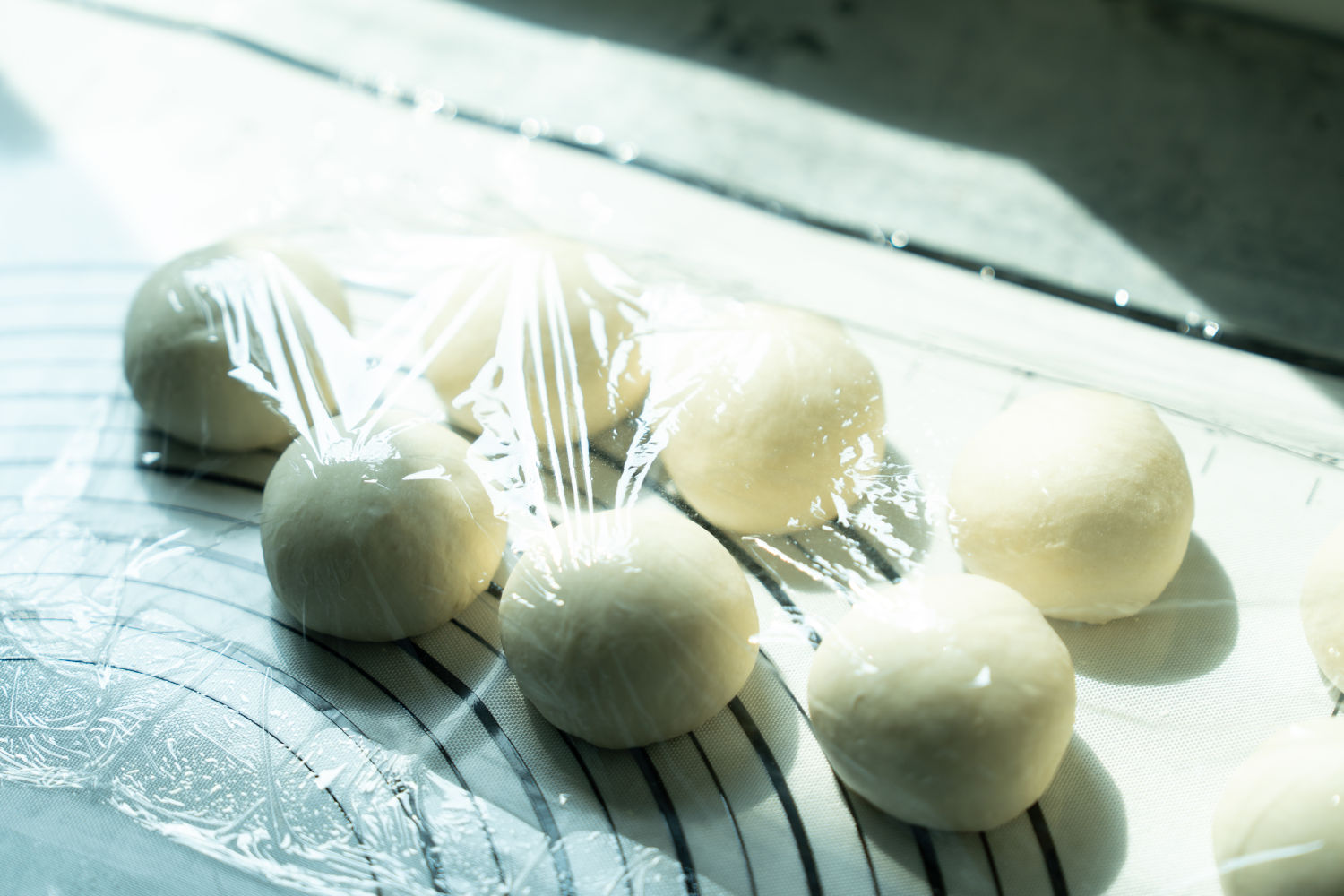
Great pizza dough takes time - a 48- to 72-hour cold ferment in the fridge develops flavor that a same-day dough just can't match. But nobody plans three days ahead every time a pizza craving hits.
Freezing pizza dough lets you do the slow work once and bank it for later. You get that developed, complex flavor on a weeknight without any planning. The catch is that freezing dough isn't quite as simple as tossing it in a bag and hoping for the best. When water freezes, it expands into ice crystals that puncture yeast cell membranes. Those ruptured cells leak a compound called glutathione, which actively breaks down gluten bonds - that's why badly frozen dough comes out sticky, slack, and impossible to shape. You're not just losing yeast; the dead yeast is sabotaging the gluten on its way out.
The good news: with the right adjustments, frozen dough can perform remarkably close to fresh. Here's how to do it right.
Adjust Your Recipe Before You Freeze
If you're making a batch specifically to freeze, a few small tweaks go a long way. Standard dough recipes assume the yeast will be alive and active when it's time to bake - freezing changes that math.
Use more yeast. Increase your yeast by 50% to 100% over what you'd normally use. A meaningful percentage of yeast cells die during freezing, so you're essentially building in a buffer. If your recipe calls for 1g of instant dry yeast, bump it to 1.5g–2g.
One thing worth knowing: not all yeast handles freezing equally. Fresh (compressed) yeast is the most resilient - it's already hydrated and its cell membranes handle ice crystal stress better. Instant dry yeast is a solid middle ground (and what most home bakers use). Active dry yeast is the most vulnerable, since it's already been stressed once during dehydration and takes a second hit from freezing. If you're using active dry, lean toward the full 100% increase. And if you're working with a sourdough starter, be aware that wild yeast is the most fragile of all - expect a longer recovery time after thawing and consider freezing only after a full ferment so the flavor work is already done. For a full comparison of how these yeast types perform beyond freezing, see my yeast guide.
Add some olive oil. Fat coats the gluten strands and yeast cells, acting as insulation against ice crystal damage. Even 2–3% of your total dough weight in olive oil makes a noticeable difference in how the dough performs after thawing. If your recipe doesn't already include oil, replace a small portion of your water weight with olive oil.
Don't shy away from hydration. Doughs in the 65%+ hydration range actually hold up better in the freezer. The extra moisture acts as a buffer against freezer burn (ice slowly sublimates - goes straight from solid to vapor - causing dehydration over time). You'll lose a small amount of water during storage anyway, so starting with more gives you a cushion. Just keep in mind that high-hydration doughs ferment faster, so freeze them promptly once they've hit the stage you want.
If the percentages are making your head spin, the PizzaLogic Dough Calculator handles all of this - just plug in how many dough balls you want, pick your pizza style, and it gives you exact weights for every ingredient. You can adjust the yeast and oil from there without guessing.
Level Up: Two Additives Worth Trying
If you're batch-freezing regularly and want to push the quality even further, two pantry-friendly additions can make a real difference:
A pinch of ascorbic acid (vitamin C). Just a tiny amount - about 0.01% to 0.02% of your flour weight, which works out to roughly a small pinch for a standard home batch - strengthens the gluten network by promoting disulfide bonds. This directly counteracts the glutathione damage from frozen yeast cells. The result is better oven spring and a more elastic dough after thawing. You can find ascorbic acid powder in most health food stores or online.
Diastatic malt powder. When yeast "wakes up" after a freeze, it's hungry and weakened. Diastatic malt provides enzymes that convert starch into simple sugars, giving the surviving yeast a ready food source. This translates to a more vigorous final rise and better crust browning. A teaspoon per 500g of flour is a good starting point.
Neither of these is required - the yeast, oil, and hydration adjustments above will get you 90% of the way there. But if you're the type who likes to optimize, these two are the highest-value additions you can make.
Three Ways to Freeze Pizza Dough
Not all freezing is equal. The method you choose depends on how much time you have now versus how much time you want to spend later.
Method 1: Freeze Right After Mixing (Best for Long-Term Storage)
This is the simplest approach. Mix and knead your dough, portion it into balls, and freeze it before any significant fermentation happens. The yeast is still mostly dormant and compact, which means it survives the freeze better. The gluten network hasn't been stretched by gas expansion yet either, so it holds up well against ice crystal displacement.
The tradeoff: You'll need to thaw the dough and then give it a full rise (12–24 hours in the fridge, or 4–6 hours at room temperature) before baking. The flavor won't be quite as developed as a pre-fermented dough, but it's still far better than store-bought.
Storage life: Up to 3–4 months vacuum sealed. About 4–6 weeks in a standard freezer bag.
Method 2: Freeze After a Full Cold Ferment (Best Flavor)
This is the move if flavor is the priority. Let your dough do a full 48–72 hour bulk ferment in the fridge, then portion it into balls and freeze. All that slow fermentation work - the tangy, complex flavors from organic acids and alcohols produced during long enzymatic activity - gets locked in.
The tradeoff: Since the yeast has already been working for days and then gets hit with a freeze, you lose more yeast viability. The cells are larger and more active at this stage, making them more vulnerable to ice crystal damage. That 50–100% yeast boost matters most here. You'll also want to give the thawed dough a shorter room-temperature proof (2–4 hours) to let the surviving yeast generate enough gas for a good rise.
Storage life: 2–3 months vacuum sealed. About 3–4 weeks in a freezer bag. The flavor is already developed, so there's less reason to store it as long.
Method 3: Par-Bake, Then Freeze (Fastest Path to Pizza Night)
This is the method most home cooks overlook, and it's arguably the most practical for busy weeknights. Because you're baking before freezing, you've already locked in the rise and structure - yeast viability and gluten weakening are no longer concerns.
- Shape your dough and stretch it onto a lightly oiled sheet pan or pizza screen.
- Bake at 450°F (230°C) for 4–6 minutes - just until the crust is set and barely starting to color. It should feel firm but look pale.
- Pull it out, let it cool completely on a wire rack (this prevents the bottom from getting soggy with condensation).
- Stack the par-baked crusts with parchment between each one, wrap the stack tightly, and freeze.
When pizza night arrives, you go straight from freezer to oven. Top the frozen crust, bake at full heat (500°F+ or as hot as your oven goes) for 8–12 minutes, and you're eating in under 15 minutes total. No thawing required. For the full technique, see my complete guide to par-baking pizza crust.
Storage life: Up to 6 months, even in a standard freezer bag.
How to Package Dough for the Freezer
Air is what causes freezer burn, so your goal is eliminating as much of it as possible.
1. Portion into balls. Size your dough balls to match the pizza style you plan to make. This matters more than people think:
- Neapolitan (10–12" pie): 250–280g per ball
- New York style (14–16" pie): 350–400g per ball
- Pan / Detroit style: 400–500g depending on pan size
- Personal size (8–9"): 180–220g per ball
Not sure what weight to use? The PizzaLogic calculator lets you pick your pizza style and size, then tells you the exact dough ball weight. It takes the guesswork out of portioning.
2. Coat each ball in olive oil. A thin layer all over. This prevents the surface from drying out, provides an extra hydrophobic barrier against moisture loss, and makes the plastic wrap or bag release cleanly after thawing.
3. Flash freeze first. Space the oiled balls on a parchment-lined sheet pan and freeze for 1–2 hours until they're solid. This step prevents them from sticking together or getting squished into flat discs when you bag them. It also means you can vacuum seal without the sealer compressing the dough out of shape.
4. Package tightly. Once solid, your two best options:
- Vacuum seal (the gold standard): Removes virtually all air. Gets you 3–6 months of quality storage.
- Double wrap + freezer bag: Wrap each ball tightly in plastic wrap, pressing out every pocket of air, then place into a heavy-duty freezer bag and squeeze out the remaining air before sealing. Good for 4–6 weeks.
5. Label everything. Write the date, dough ball weight, pizza style, and hydration percentage on the bag with a Sharpie. You will absolutely forget what's in there two months from now. Trust me on this one.
Your Freezer Matters More Than You Think
Not all freezers perform the same, and it impacts how long your dough stays good.
Chest freezers are the best option for long-term dough storage. They maintain a more consistent temperature because cold air sinks and doesn't rush out every time you open the lid. If you're serious about batch-freezing dough, a small chest freezer is worth the investment.
Upright freezers with manual defrost are the next best thing. They hold temperature reasonably well.
Self-defrosting (frost-free) freezers - which is what most people have built into their fridge - are the trickiest. They work by cycling the temperature up periodically to melt frost buildup, which means your dough goes through repeated freeze-thaw micro-cycles. Each cycle melts small ice crystals and reforms them as larger ones, causing cumulative damage to both gluten and yeast over time. If this is what you've got, store dough in the very back of the freezer (most stable temp zone) and plan on shorter storage times.
How full the freezer is also matters. A full freezer holds temperature better than a half-empty one. All that frozen mass acts as thermal ballast. If your freezer is mostly empty, the temperature swings more with every door opening.
How to Thaw Frozen Pizza Dough
Thawing is where most people mess up. I cover this in much more detail in my How to Thaw Pizza Dough guide, but here's the short version: the goal is to bring the dough back to working temperature slowly enough that the yeast reactivates gradually and the gluten relaxes.
The fridge method (recommended): Move the frozen dough ball from the freezer to the fridge 12–24 hours before you plan to bake. Leave it in its packaging. It'll thaw slowly and evenly, and the gradual temperature change allows moisture to reabsorb into the protein matrix instead of pooling on the surface. Once fully thawed, give it 2–4 hours at room temperature to temper - this lets the yeast wake up and the gluten relax so you can stretch it without it snapping back.
The countertop method (when you forgot to plan ahead): Place the dough ball - still wrapped - on the counter for 2–4 hours, depending on the size of the ball and room temperature. Once it's thawed and pliable, give it another 1–2 hours uncovered (on an oiled plate, draped with a damp towel) to let it come to room temp and proof slightly.
The cold water bath (when you really forgot to plan ahead): Submerge the sealed dough bag in a bowl of cool (not warm, not hot) water. This can get you to a full thaw in 1–2 hours. The water conducts heat much more evenly than air, so you avoid the uneven thawing problems of more aggressive methods. Just make sure the seal is watertight - you don't want waterlogged dough.
What to avoid: Don't microwave it. Don't use hot water. Aggressive thawing creates uneven temperatures inside the dough ball - the outside gets warm and gassy while the core is still frozen. If you absolutely must use the microwave's defrost setting, do 10-second bursts, flipping and rotating between each one. But honestly, the cold water bath is faster and produces better results. Plan B before plan C.
Baking with Previously Frozen Dough
Expect a few differences compared to baking with fresh dough:
It may need a longer final proof. Since some yeast died during freezing, the surviving yeast needs more time to generate gas. Give it an extra 30–60 minutes of room-temperature proofing beyond what you'd normally do. You're looking for the dough to feel puffy, light, and slightly jiggly - the "poke test" still applies (press with a finger; the indent should spring back slowly).
If the dough seems sluggish even after a long proof, try the DIY proofer trick: place it in a cold oven with a pan of boiling water on the rack below. The warm, humid environment can coax reluctant yeast back to life.
Oven temperature matters even more. A screaming hot oven is always important for pizza, but it's especially important with frozen-then-thawed dough. The gluten has been slightly weakened by ice crystals (and the glutathione released from ruptured yeast), so you want fast, aggressive heat to get oven spring before the structure relaxes. Preheat your stone or steel for a full hour at your oven's max temp (usually 500–550°F).
A note for outdoor oven users: If you're baking in an Ooni, Gozney, or wood-fired oven, achieving leopard spotting - those charred bubbles on the cornicione that signal a well-fermented crust - is a bit harder with frozen dough. The slightly weakened gluten reduces gas retention near the surface. Make sure the dough is fully proofed until it's visibly bubbly and has roughly doubled in size. Keep your flame on medium-high during the launch for strong top heat, and if the crust isn't spotting, lift the pizza toward the dome with your peel for a few seconds to catch the radiant heat.
The crumb will be slightly different. Even with the yeast boost, the crumb structure of a previously frozen dough is usually a touch tighter and more uniform than a never-frozen one. It's still good pizza - the flavor is all there - but if you're chasing those big, Instagram-worthy cornicione bubbles, keep your expectations realistic. That said, the consistent, tighter crumb can actually be a feature for certain styles. New York, Detroit, and thin-crust tavern-style pizza all benefit from a more uniform structure, so frozen dough can genuinely work in your favor depending on what you're making.
Troubleshooting: When Frozen Dough Won't Cooperate
Sometimes a dough ball comes out of the freezer and just doesn't perform. Before you throw it away, figure out what went wrong.
First, check if it's actually spoiled. Dough that smells rancid or has a grayish color with dark flecks (mold or dead yeast colonies) should be discarded. Don't risk it.
Flat and sticky ≠ spoiled. If the dough looks and smells fine but won't rise and feels like a wet, slack mess, that's structural failure - likely glutathione damage from ice crystals rupturing too many yeast cells. The dough isn't dangerous, it just can't do its job anymore. You've got two options:
Option 1: The pâte fermentée rescue. Instead of tossing the dead dough, use it as a pre-ferment in a fresh batch. Mix up a new batch of dough and incorporate the old, flat dough at up to 50% of the flour weight. The old dough brings all the complex flavor it developed during its original fermentation, and the fresh yeast in the new batch provides the rise and structure. It's actually a technique with a name in professional baking, and the results can be excellent.
Option 2: Repurpose it. Flat dough makes perfectly good flatbread, crackers, or focaccia where a big rise isn't the point. Roll it thin, brush with olive oil, hit it with salt and rosemary, and bake it hot. Not what you planned, but not a waste either. I have a full list of things to make with leftover pizza dough if you need ideas beyond flatbread.
Quick Reference
| Freezer Bag | Vacuum Sealed | |
|---|---|---|
| Pre-ferment dough | 4–6 weeks | 3–4 months |
| Post-ferment dough | 3–4 weeks | 2–3 months |
| Par-baked crusts | 2–3 months | Up to 6 months |
Batch It and Bank It
The real power move here is making freezing part of your regular pizza routine. Next time you mix up dough, double or triple the batch. Eat pizza that weekend with the fresh stuff, and freeze the rest. A month from now, you'll pull a dough ball out of the freezer on a Tuesday morning, and by dinner you'll have pizza that tastes like you planned it for days - because technically, you did.
Need help scaling up a recipe? PizzaLogic's dough calculator makes it painless to scale any batch size while keeping all your ratios dialed in. Pick your style, set the number of dough balls, and it handles the math.
Happy baking.