
Ever notice how the best pizzerias have crust that tastes completely different from what you get rushing dough together on a Friday night? That flavor - the slight tang, the toasty browning, the way it practically stretches itself - doesn't come from a secret ingredient. It comes from time.
Cold fermentation (letting your dough slowly rise in the fridge instead of on the counter) is one of the simplest upgrades you can make to your home pizza. But it raises a practical question: how long can pizza dough actually sit in the fridge before it crosses the line from "perfectly aged" to "past its prime"?
The short answer is 1 to 5 days, depending on your flour, your yeast level, and your fridge temperature. But the details matter quite a bit, so let's get into it.
The General Timeline
Day 1 (24 hours): The dough is usable but still young. You'll get a clean, mild flavor - pleasant, but nothing special. If you're used to same-day dough, even this short cold ferment will feel like an improvement.
Days 2–3 (48–72 hours): This is where most home pizza makers should aim. By now, enzymes have broken down enough starch into simple sugars that your crust will brown more evenly through the Maillard reaction and develop a noticeably deeper, more complex flavor. The gluten has also had time to relax, which makes the dough much easier to open by hand without springing back on you. There's a nutritional benefit too: during this window, fermentation breaks down phytic acid - an anti-nutrient in wheat that blocks absorption of minerals like iron and zinc - and the slow consumption of starches results in a lower glycemic index compared to same-day dough. Better flavor and easier on your body.
Days 4–5 (96–120 hours): You're pushing into advanced territory. A strong bread flour or a high-W 00 flour (W280+) can handle this, but all-purpose flour usually can't - the gluten network starts falling apart, and the dough turns slack and sticky. If you want to experiment with longer ferments, you'll need to reduce your yeast significantly. PizzaLogic's dough calculator can help you dial in the right amount for your target timeline.
Beyond 5 days: Honestly, you're gambling. Some experienced bakers push dough to 6 or 7 days with very low yeast and very strong flour, but for most recipes, you'll end up with a dough that's over-fermented, hard to handle, and doesn't taste great. If you bought pre-made dough with preservatives or dough conditioners, it may hold up a bit longer - see our guide to where to buy pizza dough for more on what to expect from store-bought options.
What Affects How Long Your Dough Lasts?
Not all doughs age at the same rate. A few things make a real difference:
Yeast quantity is the single biggest factor. More yeast means faster fermentation, which means your dough will peak - and then decline - sooner. A same-day recipe that uses 1% instant dry yeast will over-proof in the fridge within a couple of days. A recipe designed for a 72-hour cold ferment might use as little as 0.1%. This is the main variable you should adjust when planning ahead. My guide to the best yeast for pizza has a reference chart of yeast percentages by fermentation time.
Flour strength determines how long the gluten structure can hold up under prolonged fermentation. (Different flours also require different hydration levels - something worth keeping in mind when planning a long ferment.) Enzymes (specifically proteases) gradually soften and break down gluten over time. High-protein bread flour and high-W Italian 00 flour resist this much longer than all-purpose flour. If you're planning anything beyond 48 hours, strong flour isn't optional - it's necessary. My flour guide covers which flours work best for long fermentation schedules.
Fridge temperature matters more than most people realize. The ideal range is 38°F–42°F (3°C–5°C). Most home fridges run a little warmer than this, especially near the door. A few degrees might not sound like much, but yeast activity roughly doubles with every 15°F increase, so a fridge running at 45°F will ferment your dough meaningfully faster than one at 38°F. On the flip side, a fridge that's too cold (below 36°F) can push the yeast into near-dormancy - the dough won't spoil, but it also won't develop much flavor or texture improvement. Store your dough balls on a back shelf, away from the door, where the temperature is most stable.
Salt does more than flavor your dough - it's a preservative. Salt strengthens gluten bonds, slows yeast metabolism, and inhibits the protease enzymes that gradually break down your dough's structure. Most pizza dough recipes call for around 2–3% salt by flour weight, and staying in that range gives you noticeably more fridge life than a low-salt dough. That said, pushing much above 3% can make the dough tight and hard to stretch, so there's a ceiling.
Sugar, oil, and other enrichments also play a role. Sugar feeds the yeast directly, which can accelerate fermentation - this is why most professional long-ferment recipes skip added sugar entirely and let the enzymes release sugars from the starch at a controlled pace. Oil coats the gluten strands and can slightly slow down enzymatic breakdown, and it also slows starch retrogradation (the main reason bread goes stale), which keeps your dough more pliable over a multi-day ferment. Enriched doughs (like ones with milk or eggs) tend to spoil faster because of the additional nutrients available to bacteria.
Sourdough dough is a special case. If you're using a sourdough starter instead of (or alongside) commercial yeast, your dough will behave differently in the fridge. The lactic acid bacteria in the starter lower the dough's pH, which acts as a natural preservative against harmful pathogens - but that same acidity accelerates gluten breakdown. Sourdough pizza dough tends to have a shorter, more precarious peak than commercial-yeast dough, and it can go from perfectly mature to over-fermented faster than you'd expect. Keep a closer eye on it, especially past the 48-hour mark. If you're interested in using sourdough as a pizza preferment - whether adding starter directly or building a levain - I cover the full process in my guide to prefermented pizza dough.
How to Tell If Your Dough Has Gone Bad
There's a real difference between dough that's mature and dough that's spoiled. Mature dough smells yeasty, slightly tangy, maybe a little boozy - that's just the byproducts of fermentation. That's fine. Here's what to watch for as it ages:
A sharp vinegar smell means the dough is very mature - probably at or just past its peak. It's not spoiled, but the acetic acid levels are high, and your crust will likely taste noticeably sour. You can still use it, but you're on borrowed time. This is especially common with cold-fermented dough since lower temperatures favor acetic acid production over the milder lactic acid.
A sour-milk or rancid smell is a different story. If the aroma has shifted from "sharp but clean" to something that makes you wince, bacterial contamination has taken over. Toss it.
Mold. A grayish tint on the surface is usually just oxidation and is harmless - you can fold it back in. But fuzzy spots (white, green, or black) are mold, and that means the whole dough ball needs to go. Don't try to cut around it.
Liquid pooling on top. A thin layer of liquid (sometimes called "hooch" in sourdough baking) means the yeast has consumed all the available sugars and the dough is exhausted. It might still be technically safe, but the resulting pizza will be flat and bland.
Dough that tears immediately. If you can't stretch it at all without it ripping - not even gently - the gluten is too far gone. You won't get any structure out of it in the oven.
Storage Tips That Actually Matter
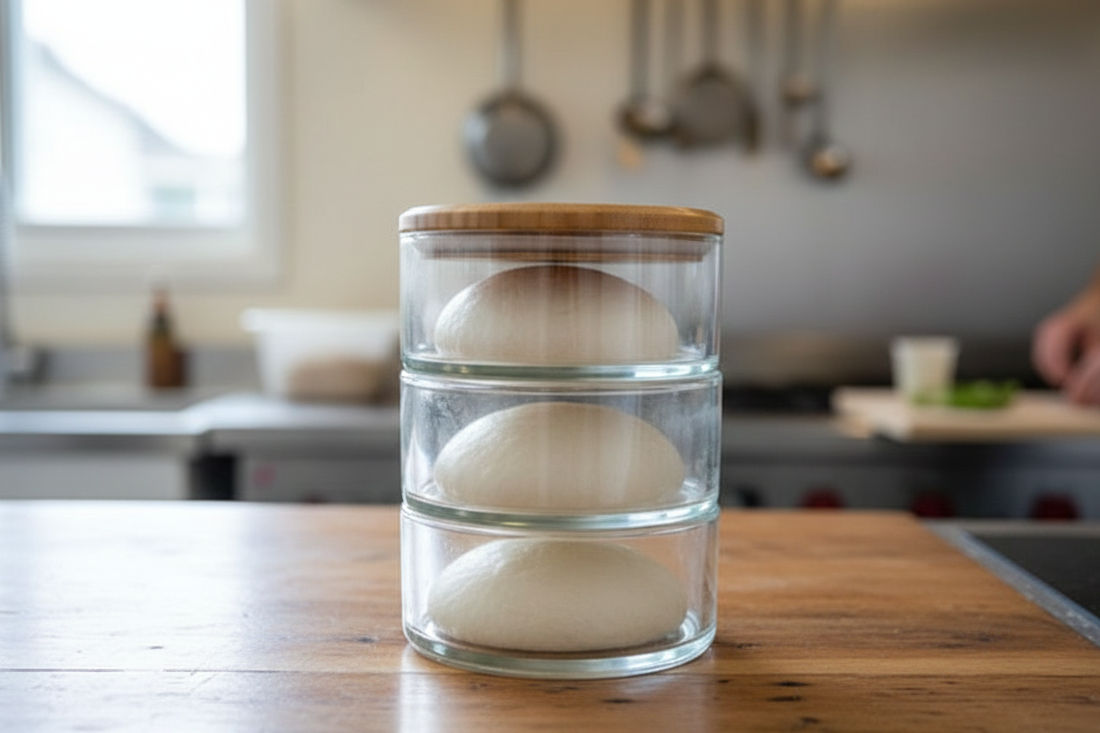
Ball it up before it goes in the fridge. Don't refrigerate a big bulk mass and plan to divide it later. A large mass of dough acts as a thermal sink - the center of a 2kg batch can take 12 hours or more to reach fridge temperature, which means the core is still fermenting at near room-temperature speed while the outside has slowed down. You end up with an unevenly fermented dough. Portioning into individual balls right after kneading lets each one cool down quickly and ferment uniformly. Place each ball in a lightly oiled container with an airtight lid, or in a well-sealed, oiled zip-top bag with some room to expand.
Don't skip the oil. A thin coat of olive oil on the dough ball and the inside of the container prevents the surface from drying out and forming a skin. That dried-out skin doesn't rehydrate - it just becomes a tough spot in your finished crust.
Give it room. Dough will roughly double in volume during a cold ferment. If your container is too small, the dough will press against the lid, degas itself, and you'll lose some of the open crumb structure you're working toward.
Bring it to room temperature before baking. Pull your dough out of the fridge 1–2 hours before you plan to bake. Cold dough is stiff and hard to stretch, and it won't puff up properly in the oven. You want it relaxed and slightly puffy at room temperature before you open it. For more on this process (especially if you're working with frozen dough), check out my guide to thawing pizza dough.
What to Do with Over-Fermented Dough
If you forgot about your dough for a day too long and it's turned into a slack, bubbly mess - don't throw it out. It won't make great pizza, but it still has flavor locked in from all that fermentation time. A few ideas:
Focaccia is the easiest save. Pour the dough into a well-oiled sheet pan, let it spread on its own, dimple it with your fingers, hit it with olive oil and flaky salt, and bake at 425°F. The pan provides all the structure the dough no longer has.
Flatbread or crackers. Roll the dough out as thin as you can, brush it with oil, and bake it until crisp. The extended fermentation actually works in your favor here - you get a deeper, nuttier flavor that pairs well with dips or cheese.
Pizza fritta. Tear off small pieces and fry them in neutral oil at 350°F until they puff up and turn golden. The high heat of frying creates a dramatic oven spring that you won't get from baking over-proofed dough. Top them while they're still hot. You can also shape them into small balls for zeppoles - dust with powdered sugar right out of the fryer. For more ideas beyond these, see my full guide on what to do with leftover pizza dough.
What About Freezing?
If you know you won't use your dough within 5 days, freeze it rather than hoping for the best. The key is to freeze it after the initial rise but before it's used up its nutrient supply - ideally within the first day or two of refrigeration.
Coat each dough ball lightly in olive oil, wrap it tightly in plastic wrap, and place it in a freezer-safe bag with the air pressed out. Homemade dough holds up well for about 3 months in the freezer; store-bought dough with stabilizers can go longer, up to 6 months.
When you're ready to use it, move the frozen dough to the fridge for 12–24 hours to thaw gradually, then let it sit at room temperature for 30–60 minutes before shaping. Rushing the thaw (like leaving it on the counter from frozen) can dry out the exterior while the inside is still a cold brick. For the full breakdown on thawing methods, check out my guide to thawing pizza dough.
Planning Ahead
The whole point of cold fermentation is that it lets you do the work in advance and get better results for it. If you're planning pizza night for Saturday, mix your dough on Wednesday or Thursday, portion it into balls, and let the fridge do the rest.
If you need help adjusting yeast quantities for a specific ferment length, PizzaLogic's pizza dough calculator will do the math for you - just set your target hours and it'll scale the yeast accordingly.