
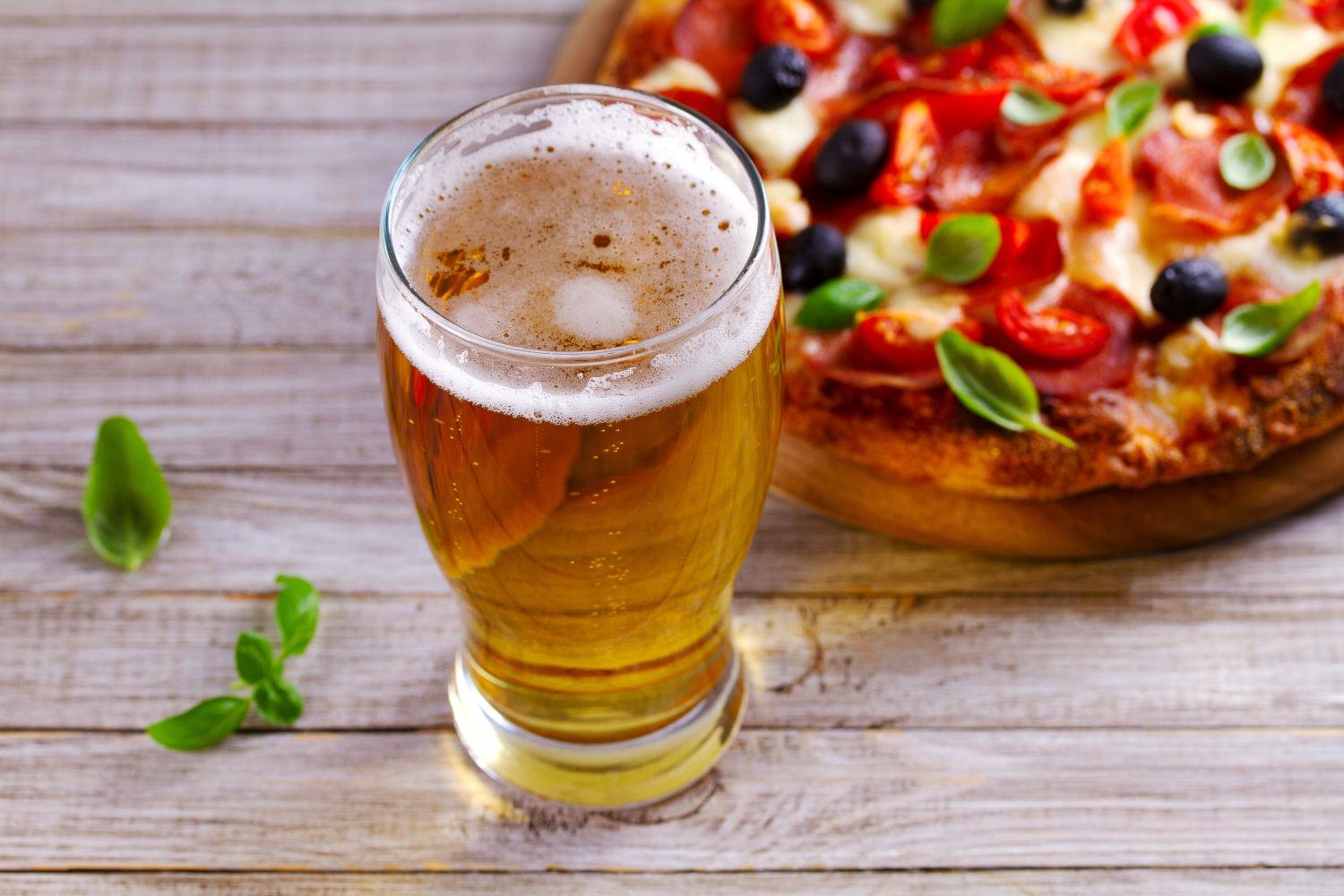
Making great pizza at home is a process. You start with a basic recipe and a sheet pan, maybe graduate to a pizza stone or steel, try a long cold ferment in the fridge, experiment with different flours, and beyond. If you get into the hobby, you'll find yourself chasing that pizzeria-quality crust - crisp outside, chewy inside, with a depth of flavor that plain flour and water struggle to deliver on their own.
Beer in pizza dough might sound like a novelty or a gimmick, but it's actually one of the more logical upgrades you can make. Replacing some or all of the water in your dough with beer is a scientifically sound way to boost flavor, improve texture, and get better browning. It's low-effort and high-reward, and it doesn't require you to rethink your entire process.
If you've been curious about beer crust pizza or just want a reliable beer dough pizza recipe, this covers the why and the how.
Why Beer Works in Pizza Dough
Bread and beer share the same basic ingredients - grains, water, yeast. They've been linked for thousands of years. Combining them in a dough isn't a stretch; it's a reunion.
Here's what beer actually contributes:
Flavor depth without the wait. A traditional long-fermented dough develops complex flavor because yeast slowly breaks down starches over 24 to 72 hours. Beer arrives pre-loaded with those fermented, bready, malty flavors. It won't replicate a three-day cold ferment, but it adds a richness that a same-day dough made with plain water can't touch. Think of it as a shortcut to complexity.
A lighter, crispier crust. The dissolved CO2 in beer gives the dough a small head start on aeration. Those carbonation bubbles create tiny air pockets in the crumb before your yeast even gets going. The result tends to be a crust that's a bit lighter and airier, with a crisp outer shell. This is especially noticeable in thin-crust styles where every bit of texture matters.
Better browning. If you've ever pulled a pale, anemic-looking crust out of a home oven, beer could help. It contains residual sugars from malted grains - sugars the brewer's yeast didn't fully consume. Those sugars are fuel for the Maillard reaction, the chemical process responsible for browning and savory flavor development. A beer dough browns more readily, which is a real advantage when you're working with a home oven that tops out at 500-550°F instead of the 800°F+ of a commercial pizza oven.
A Little Kitchen Science (Skip If You Just Want the Recipe)
You don't need a chemistry background for this, but understanding the mechanics makes you a better baker.
The alcohol question. Most of the alcohol evaporates during baking, especially at pizza-baking temperatures. A slice of beer crust pizza contains negligible alcohol - less than what naturally occurs in ripe fruit or a piece of sourdough bread. It's a non-issue for kids.
Yeast behavior. Beer contains amino acids and simple sugars (primarily maltose) that give your baker's yeast an immediate food source. This can jumpstart fermentation, so keep an eye on your rise time - it may be slightly shorter than you're used to.
Gluten development. Most beer has a mildly acidic pH, roughly 4.0 to 4.5. Yeast performs well in slightly acidic environments, and that acidity can actually strengthen your gluten network. It's a similar principle to why sourdough has such good structure - the acidity tightens things up. The practical result is a chewier, more structured crumb.
So what does beer pizza dough taste like? Not like drinking a beer. The flavor is subtler than you'd expect - richer, slightly nutty, with a malty warmth in the background. It just tastes like better bread. The beer character is present but not dominant, more of a supporting player than the lead.
Choosing the Right Beer
The style of beer you use matters more than the brand. Different styles will steer the flavor in different directions.
Best for most pizzas: Malt-forward, moderate beers. Lagers, pilsners, amber ales, brown ales, and bocks all work well. They add that malty dimension without competing with your toppings. A standard American lager is honestly a solid choice if you want a subtle upgrade without committing to a strong flavor direction.
Use carefully: Heavily hopped beers like IPAs. Hop bitterness concentrates as the dough bakes, and what tastes pleasantly bitter in a glass can become harsh in a crust. If you love IPAs, try a session IPA with lower IBUs rather than a double IPA.
For something different: Stouts and porters produce a noticeably darker crust with deep, roasted, almost pumpernickel-like notes. It's a strong personality that needs equally bold toppings - think barbecue chicken, smoked gouda, caramelized onions, or hearty sausage. Not an everyday choice, but fun to experiment with.
Non-alcoholic beer works too. If you want the malt flavor and sugars without any alcohol, NA beer is a perfectly valid substitution. You'll still get the browning benefits and most of the flavor complexity. The only thing you lose is some of the carbonation lift, since many NA beers are less carbonated.
How to Make Beer Pizza Dough
This is the easy part. You can adapt almost any existing pizza dough recipe - just swap the water for beer.
The basic rule: Substitute the water in your recipe with an equal amount of beer by weight. If you're working with a recipe from the PizzaLogic dough calculator, just use beer where it calls for water. Your hydration percentage stays the same.
A few practical notes:
Temperature matters. Don't use ice-cold beer straight from the fridge - it'll shock your yeast and slow the rise dramatically. Let it sit on the counter for 30 to 60 minutes, or until it's around room temperature (roughly 68-72°F / 20-22°C). If you're doing a same-day bake and want an active rise, slightly warm beer (around 100°F / 38°C) works too, though you'll lose some carbonation.
Don't flatten it first. As mentioned above, the carbonation can add to the dough, and isn't something to be avoided. Just pour slowly when mixing to avoid a foam eruption in your bowl.
You can skip added sugar. If your recipe includes a teaspoon or two of sugar to feed the yeast, the beer's natural maltose handles that job. Keep your salt and olive oil as-is.
Hydration adjustments. Beer is mostly water, but it does contain dissolved solids (sugars, proteins) that make it slightly thicker. In practice, the difference is minimal. If your dough feels a touch stickier than usual, hold back a tablespoon or two of beer rather than adding extra flour. You can always add liquid; taking it back out is harder.
A Simple Beer Pizza Dough Recipe
This makes enough for two 12-inch pizzas. If you want to scale it up or down, the PizzaLogic calculator can handle the math for you.
Ingredients:
- 500g bread flour
- 340g beer, at room temperature
- 10g fine sea salt
- 7g active dry yeast or instant yeast
- 14g olive oil
That puts you at roughly 68% hydration with a 2% salt ratio - a good all-purpose starting point.
Instructions:
-
Bloom the yeast (active dry only): Pour the room-temperature beer into a large bowl and sprinkle the yeast over the surface. Let it sit for 5 minutes until foamy. If you're using instant yeast, skip this and mix it directly with the flour.
-
Combine: Add the salt, olive oil, and about 400g of the flour to the beer mixture. Stir until a shaggy dough forms.
-
Knead: Turn the dough out onto a lightly floured surface and knead for 8 to 10 minutes, incorporating the remaining flour gradually. You want a dough that's smooth, elastic, and slightly tacky but not sticky. A stand mixer with a dough hook on medium-low works too - about 5 to 7 minutes.
-
Bulk rise: Place the dough in a lightly oiled bowl, cover with plastic wrap or a damp towel, and let it rise in a warm spot for 1 to 1.5 hours until doubled. With the beer sugars feeding the yeast, check it at the 45-minute mark - it may move faster than a plain water dough.
-
Divide and rest: Punch down the dough, divide into two equal pieces (each around 430g), and shape into tight balls. Cover and rest for 15 to 20 minutes. This relaxes the gluten and makes stretching much easier.
-
Shape and bake: Stretch your dough, add toppings, and bake at your oven's highest temperature on a preheated pizza stone or steel. Pull it when the crust is golden-brown and the cheese is bubbling with spots of char.
Pairing Beer Style with Pizza Style
Once you've made beer crust pizza a few times, you can start matching the beer to the pizza style:
- Neapolitan-style (high heat, minimal toppings): A light pilsner or lager. You want the beer to enhance, not compete with, the simplicity.
- New York-style (foldable, chewy): An amber ale or pale ale adds body that complements the chewier crumb.
- Detroit or Sicilian (thick, focaccia-like): A brown ale or bock. The deeper malt flavors work with the thicker, breadier crust.
- Grilled pizza: A wheat beer. The lighter body and slight citrus notes pair well with the smoky char from the grill.
Worth Trying
Beer in pizza dough is one of those things that sounds like a novelty but turns out to be legitimately useful. The science backs it up - better flavor, better browning, better texture - and the execution couldn't be simpler. Swap your water for beer and everything else stays the same.
Start with a beer you enjoy drinking and go from there. And if you want to dial in the exact ratios for your preferred style, the PizzaLogic dough calculator makes it easy to experiment without doing math on the back of a napkin.